
Who Owns the QSR Customer? Competing for Loyalty in a Platform-driven Market
As third-party platforms like DoorDash and Uber Eats capture more of the restaurant market, quick-service restaurants (QSRs) are losing direct customer relationships. Two industry leaders discuss how to partner with a food-delivery app to strengthen brand loyalty and increase sales.

As third-party platforms like DoorDash and Uber Eats capture more of the restaurant market, quick-service restaurants (QSRs) are losing direct customer relationships. Two industry leaders discuss how to partner with a food-delivery app to strengthen brand loyalty and increase sales.
Authors

Chris is the GM of Consumer Products and Services at Toptal. A seasoned executive who has held leadership roles in technology startups and global consultancies like EY, Nielsen, and Capgemini, Chris has built innovative partnerships with Google Cloud, AWS, and Microsoft Azure. Chris has a bachelor’s degree in engineering and math from the University of Illinois Urbana-Champaign and a bachelor’s in physics from Illinois State University.
Previously At



David is a senior marketing leader with extensive experience in the quick-service and fast-casual restaurant industry. Before becoming a fractional marketing leader and consultant, he was vice president of marketing and corporate sales at Chopt and Dos Toros, marketing director at Godiva Chocolatier, and held marketing leadership roles at Yum! Brands. David has a bachelor’s degree in psychology from Tufts, a master’s degree in hospitality management from Cornell University, and is a graduate of the Cannes Creative Academy for Young Marketers.
Previously At


Quick-service restaurants (QSRs) have always thrived on personal connection. Whether it was a familiar face at the counter or a loyalty punch card, the best brands didn’t just feed people, they knew them. But that connection is unraveling. Today, the customer experience starts with an app—and more often than not, it’s not yours.
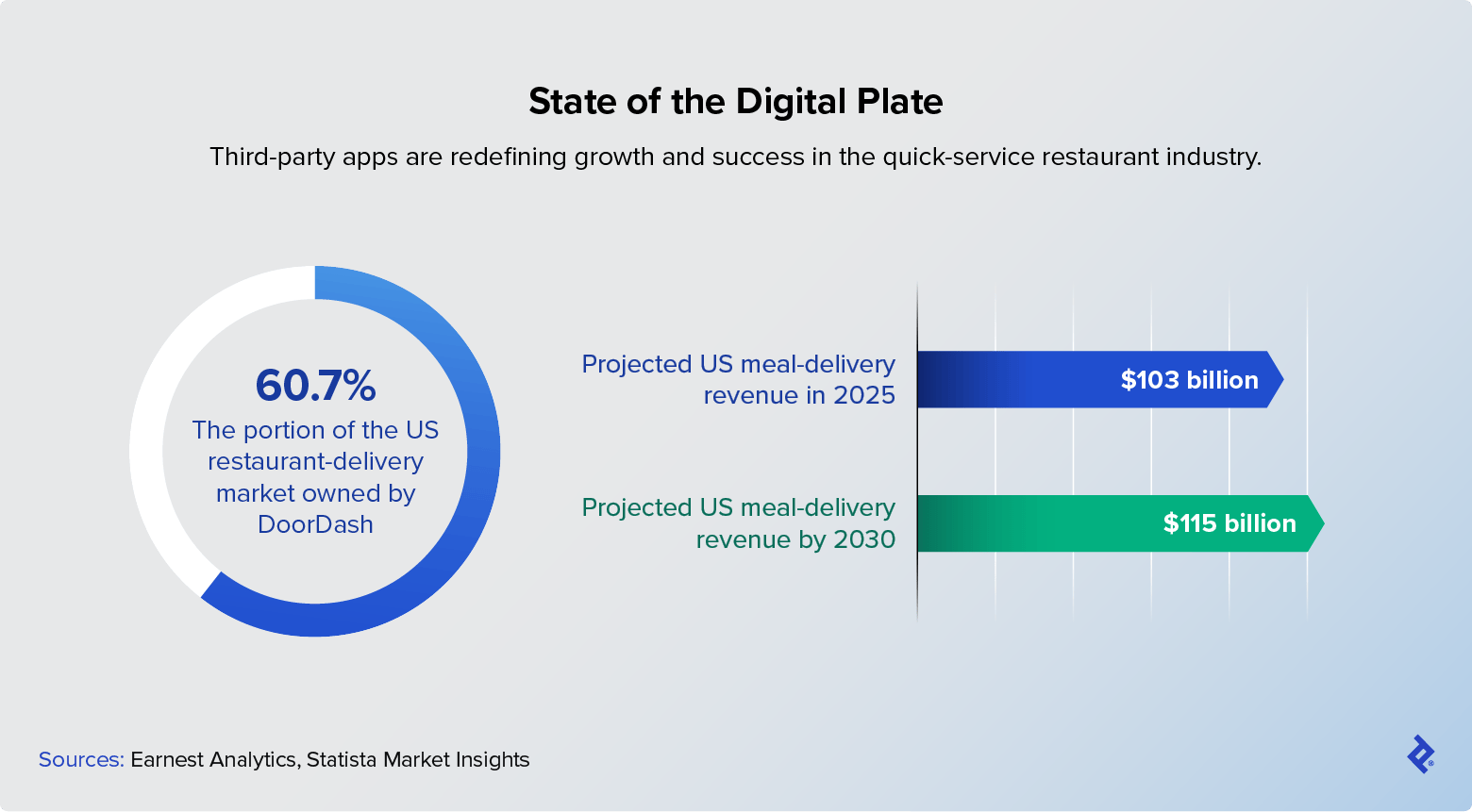
The top three platforms—DoorDash, Uber Eats, and GrubHub—have captured 93% of the US restaurant delivery market, with DoorDash alone holding nearly 61%. They’ve become the digital front door to your customer. And that door is no longer owned by you.
As delivery becomes the dominant dining revenue stream in many markets, restaurants are now forced to compete not on location or loyalty, but on placement, pricing, and promotion inside someone else’s platform. Just ask Domino’s. After years of resisting third-party delivery to protect margin and customer data, they reversed course and inked a deal with DoorDash in 2024. The rules have changed.
And the issue isn’t just about margin erosion—it’s about relationship loss. With third-party apps expanding into adjacent categories like grocery and convenience, your customer becomes their customer. You lose not only visibility, but influence.
Meanwhile, brands face mounting pressure. Consumer confidence recently dropped to its lowest level since the height of the COVID-19 pandemic, creating a condition in which diluted loyalty can further harm brands that don’t provide the updated buying experiences customers want. And QSR industry leaders like McDonald’s, Chipotle, and Applebee’s are reporting same-store sales declines, for a variety of reasons.
The dining landscape has changed and delivery platforms are no longer a side bet: US meal-delivery revenue is projected to reach $103 billion in 2025, and grow to nearly $115 billion by 2030.
Who Owns the Customer?
If the front door has moved to apps, the next question is: Who’s controlling the experience? It’s not the QSR brand. It’s DoorDash, Uber Eats, and Grubhub. Companies that were once seen as optional partners are now operating as gatekeepers to volume, visibility, and customer loyalty.
These platforms are no longer just delivery services. They’ve become:
- Retailers, capturing demand and nudging choice.
- Media networks, monetizing attention and placement.
- Data guardians, holding customer insights hostage.
- Brand filters, flattening identity into icons, ratings, and deals.
When a customer opens a third-party app, they’re not stepping into your restaurant—they’re browsing a crowded and commoditized digital marketplace. A burger is a burger. A bowl is a bowl. Unless you’re in the top results—or offering 10% off—your brand equity means less than your promo code.
And here’s the kicker: Your customer brings more value to the platform than the platform brings to you. Every new customer that finds your listing could later be sold groceries, convenience items, or alcohol—all outside your revenue stream.
That’s why progressive QSR brands are rethinking how they show up—not just on these platforms, but within them.
A Strategic Framework for Platform Engagement
To compete, QSRs need a new playbook—one that moves from passive participation on third-party apps to intentional partnership. Here’s a three-tier model for engaging with delivery platforms based on depth, data, and shared value:
Tier 1: Establish Presence
QSRs that are just getting started with third-party platforms or who are seeking to better understand the incrementality of such channels should adopt a maintenance mentality. Their objective should be to maintain a presence on the app and stay visible in order to assess the efficacy of a given platform. Engagement might remain basic in nature but efforts should be made to obtain preferred pricing in accordance with the value of the brand and its customers.
Tier 2: Expand Engagement
Once a platform has proven itself to be valuable, it’s time to build up your presence and become a virtual destination for users. This means leaning in and investing in marketing and menu opportunities on the platform such as co-branded promotions, featured listings, and test-and-learn menus. In this tier, brands should expect to engage in a more reciprocal relationship with third-party providers, identifying opportunities for joint value creation (e.g., pilot participation) and acting upon them.
Tier 3: Integrate and Lead
If consumers on a third-party platform respond positively to your brand presence, it’s time to deepen the relationship by co-creating the platform experience with the third-party provider. To play here, QSRs need to consider how to align their programs and systems with the provider at a foundational level; for instance, you might share data, integrate loyalty systems, and connect tech stacks. Operating at this level benefits both parties and provides the opportunity to leverage joint customer understanding to enhance product offerings, improve operational capabilities, and drive shared loyalty.
The Innovation Opportunity
While much of the conversation about third-party platforms focuses on risk, the truth is they also unlock massive innovation potential. Brands like Wonder and Chopt are already running with innovative marketing techniques that are only possible because of third-party platform technology, such as:
- Digital-only menus: These app-only menus are being used to test pricing, products, and exclusivity. Digital-only menus aren’t just a novelty—they’re scaling fast. The global digital menu board market, which includes both in-person physical digital menu boards and virtual and app menus, is projected to grow from $2.8 billion in 2023 to $6.5 billion by 2033, according to Data Horizon Research.
- Ghost kitchens and fulfillment-only sites: These innovations are lowering costs and expanding reach for restaurant brands. Take Wonder, for example, a virtual food hall that offers the menus of multiple restaurants out of a single kitchen for dine-in, pickup, or delivery. (Some of the food options are from established external brands; others are from chef-led microbrands found only at Wonder.) Wonder acquired Grubhub in 2024 to build awareness and reduce costs via vertical integration of a delivery fleet.
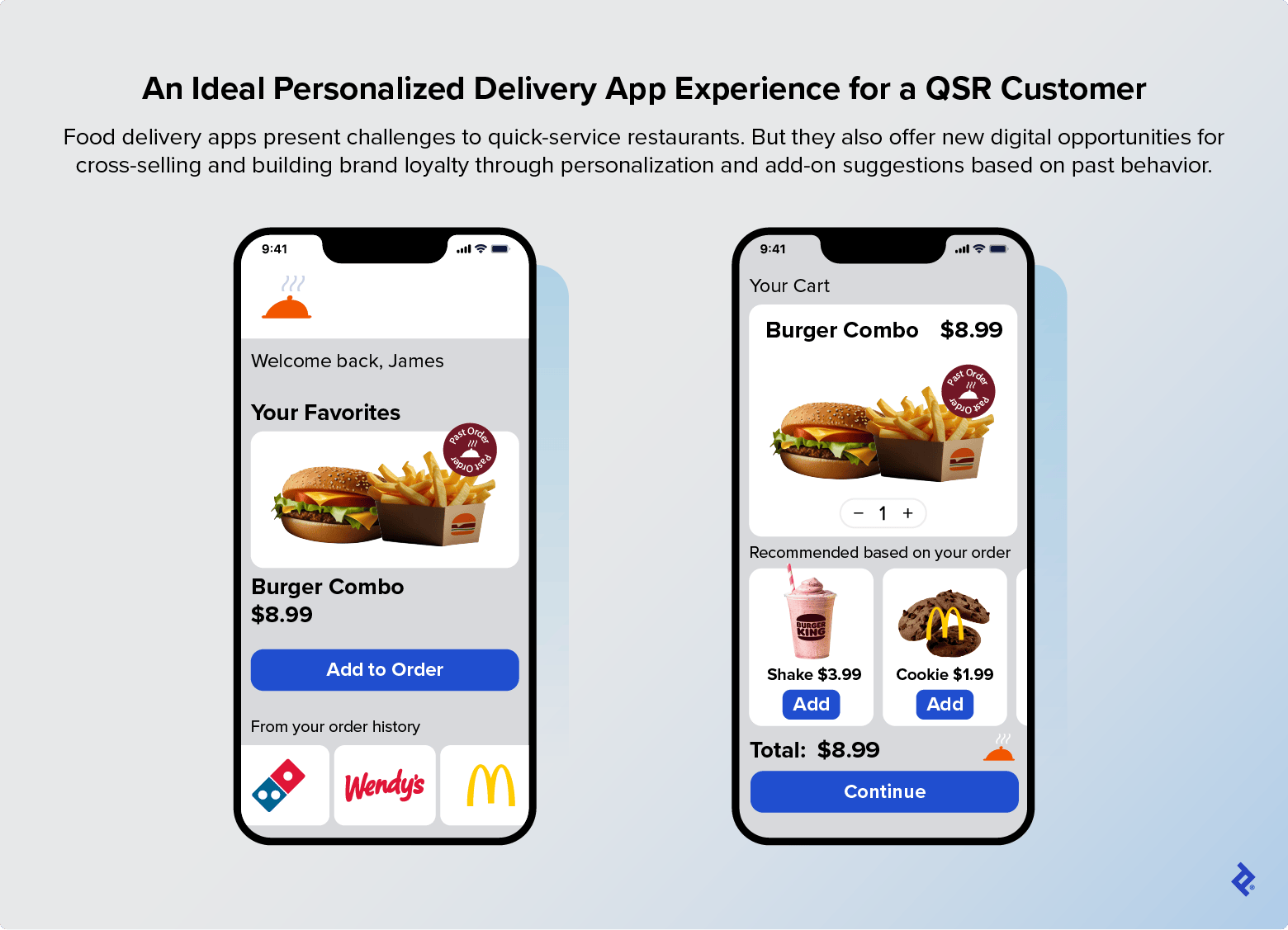
- AI-driven personalization: This feature is being layered into third-party dining platforms to improve user experience and increase your sales.
- Cross-category delivery: The ability to order multiple types of food items—like a cold beer with your burger and fries—is increasingly feasible in regulated categories like alcohol and spirits. Cross-selling of this kind can drive revenue and loyalty for restaurants.
- Pickup-only stores: Mobile-first experiences are being used to rethink QSRs’ physical footprints. For example, Chopt, the fast-casual salad player, has been innovating its physical storefronts to identify the optimal design for central business district locations, including digital-only restaurants where customers place orders via an app, or in-store via kiosks. Working alongside third-party providers, they have developed a format that improves customer experience while minimizing cost, enabling further expansion and penetration.
Repositioning QSR Strategy for Platform-driven Growth
The QSR industry doesn’t need yet another digital marketing agency or overpriced consulting firm to help them thrive in the era of third-party apps. What they need is a strategic consumer products and services partner that can deliver dining industry, marketing, and technology expertise and implementation all at once, on demand.
This is the rapid, cross-functional team approach we take when working with dining industry clients. At Toptal, we work not only with leading QSRs and restaurant chains, but also with delivery platforms themselves, giving our teams of management consultants, technology specialists, and marketing strategists a rare dual-lens view of how the entire ecosystem operates.
While third-party apps have challenged traditional notions of customer relationships, they also offer unprecedented opportunities for scaling and innovation. The familiar face at the counter may be gone, but the opportunity for meaningful connection with your customer is not. The QSR brands that will thrive in this new era are those that strategically embrace this digital transformation, and soon. The front door may now belong to the platforms, but the experience behind it—the quality, innovation, and value that keeps customers returning—remains entirely yours to own.
Have a question for Chris or his Consumer Products and Services team? Get in touch.
Authors

About the author
Chris is the GM of Consumer Products and Services at Toptal. A seasoned executive who has held leadership roles in technology startups and global consultancies like EY, Nielsen, and Capgemini, Chris has built innovative partnerships with Google Cloud, AWS, and Microsoft Azure. Chris has a bachelor’s degree in engineering and math from the University of Illinois Urbana-Champaign and a bachelor’s in physics from Illinois State University.
PREVIOUSLY AT

New York, NY, United States
Member since March 18, 2025
About the author
David is a senior marketing leader with extensive experience in the quick-service and fast-casual restaurant industry. Before becoming a fractional marketing leader and consultant, he was vice president of marketing and corporate sales at Chopt and Dos Toros, marketing director at Godiva Chocolatier, and held marketing leadership roles at Yum! Brands. David has a bachelor’s degree in psychology from Tufts, a master’s degree in hospitality management from Cornell University, and is a graduate of the Cannes Creative Academy for Young Marketers.
PREVIOUSLY AT