
The Future of AI in Marketing: Strategic Considerations for Enterprise Leaders
AI is reshaping marketing, from content and creative to pricing and customer service. These seven questions will help enterprise leaders cut through the noise and make smarter, more strategic choices in the age of AI.

AI is reshaping marketing, from content and creative to pricing and customer service. These seven questions will help enterprise leaders cut through the noise and make smarter, more strategic choices in the age of AI.

Jeff is the Growth and Digital Marketing Practice Lead at Toptal. He holds a bachelor’s degree from Middlebury College and an MBA from Cornell University with an emphasis in leadership and innovation. Jeff has spent the past 15 years building demand generation, content marketing, and digital programs that drive meaningful transformation and growth for both internal teams and external clients. Before joining Toptal, he held senior management roles at Accenture Song, Material, and Telus International.
Previously At


Every marketing executive is feeling the pressure to integrate AI into their operations, and to do it fast. It’s a worthy task: When used correctly, the technology can cut costs, improve targeting, and speed production. While the natural temptation is to try to retrofit AI into your existing marketing infrastructure, poorly considered AI implementations can have serious consequences on customer trust, operational costs, and team morale.
AI mistakes compound quickly, especially at large companies, affecting complex systems, thousands of employees, and millions of customers. Furthermore, each seamless and useful AI experience your customers have with another brand raises the bar for what they expect from yours. That’s why the enterprise marketing leaders who come out ahead in the AI race will be the ones who ask the right questions, not necessarily the ones who move fastest. In this article, I lay out seven questions every legacy brand or enterprise marketing leader needs to ask their teams right now, covering crucial priorities such as generative search, the risks of AI-driven personalization, and customer research.
1. Can LLMs Understand Our Most Important Content?
Google Gemini search summaries, large language model (LLM) chatbots, and AI overviews are changing the rules of search engine optimization (SEO). The share of total Google search queries triggering an AI Overview more than doubled in 2025, from 6.49% in January to 15.69% in November. And the presence of an AI overview correlates with a 58% lower click-through rate to an external website, according to a 2026 study by Ahrefs.
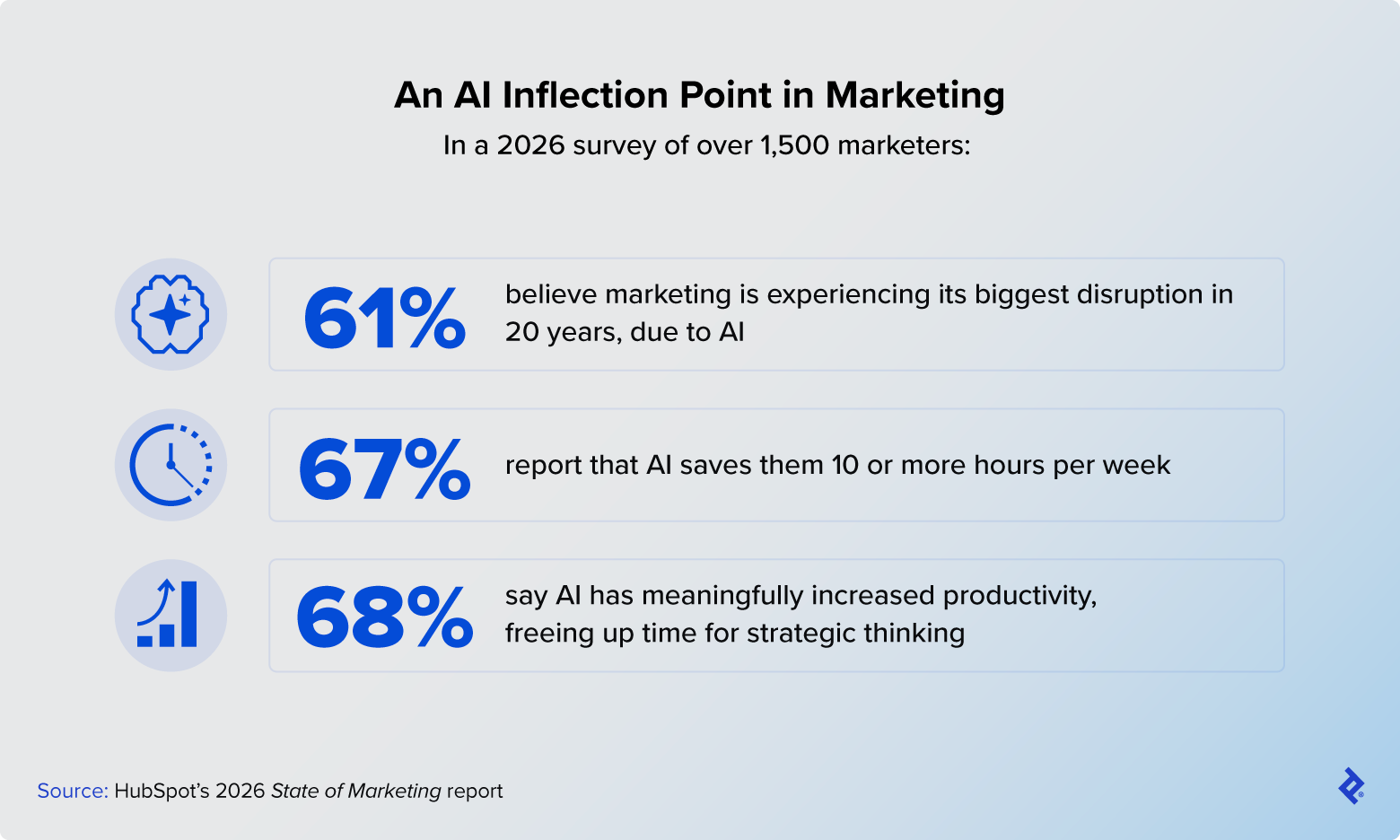
While these changes may lead to less organic traffic, they don’t have to lead to fewer sales. Customers who find your brand in an AI search are more likely to buy. According to Hubspot’s 2026 State of Marketing report, 58% of marketers say that AI referral traffic has much higher intent than traditional search.
Generative engine optimization (GEO) and answer engine optimization (AEO) focus on making sure content can be easily picked up and displayed as direct answers by generative AI (Gen AI). Owning as much of the narrative, product specifications, and other technical elements of your brand presence helps make sure your customers have access to accurate details, rather than second- and thirdhand information, or worse yet, deliberately inaccurate information spread by competitors.
Many factors that make your content more likely to show up in traditional search also support AI search, but there are some emerging differences. To give your content a better chance of being displayed to users in an AI Overview or chat interface:
- Structure each section around a direct answer, leading with the most important information in the first one or two sentences.
- Use clear subheadings and bullet points to make it easy for LLMs to parse.
- Include specific data points with clear source attributions, since research suggests that AI engines prefer to cite such content.
- Make content “dense with meaning,” without relying solely on keywords.
GEO is part of a shift toward marketing to machines as well as people. If AI systems can’t “perceive” your messaging as well as (or easier than) humans can, they won’t turn it into answers that humans see when they search.
For consumer brands, this is already a practical consideration. A major consumer packaged goods (CPG) manufacturer might manage hundreds of thousands of product detail pages, each with images, descriptions, and regulatory claims that need to be legible to both shoppers and AI systems. An emerging practice among forward-looking teams is using AI to audit and update that content at scale, while keeping human retail and category experts in the loop.
2. How Could AI Tools Improve Your Creative Output?
AI’s most immediate value to creative teams is minimizing manual, repetitive work and freeing people to focus on innovation and higher-order thinking. Surprisingly, only 15% of marketing leaders had fully automated low-value team tasks as of late 2025, according to the Capgemini Research Institute’s CMO Playbook. There’s still a lot of work to be done in implementing automation for basic operational and administrative tasks. But while that’s ongoing, marketing leaders shouldn’t ignore more substantive augmentations.
For brands with large product portfolios, there’s an immediate opportunity in creative variation and testing. Rather than producing just a handful of hero assets, teams can generate hundreds of variants and test different product angles, packaging shots, and calls-to-action across e-commerce and social platforms. AI accelerates the generation and initial scoring of these assets, but human brand and category experts remain essential for making sure the work is on-brand, compliant, and resonant.
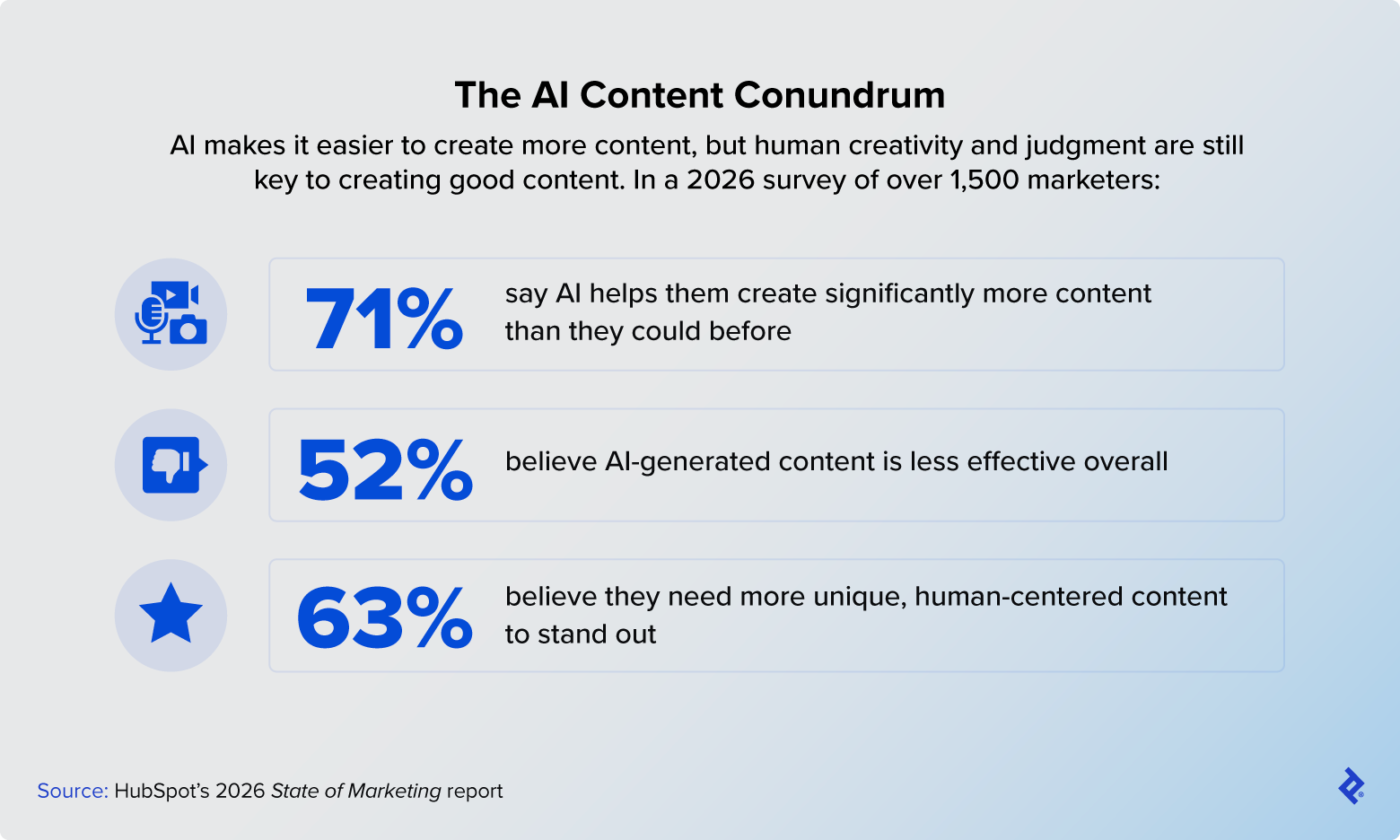
Meanwhile, tools like Writer, Typeface, and Hightouch let creatives dial in qualitative copywriting attributes like brand voice and scale them across many assets. That said, caution and editorial judgment are advised when generating content with AI: 52% of marketers in Hubspot’s 2026 State of Marketing report believe AI-generated content is less effective overall, and 53% have a hard time making their messages stand out in an AI-saturated market. Even with well-governed, human-in-the-loop processes, the risk at scale is producing work that is technically fine but indistinguishable from everything else. And 2025 research from Raptive shows that consumers who suspect they’re reading AI-generated copy disengage and trust the content less, even if it was actually crafted by humans.
For visual production, enterprise-ready tools like Adobe Firefly, Google Veo, Runway, and Midjourney are helping creative teams move faster from concept to asset by accelerating image generation, video creation, and visual iteration. Some tools may allow brands to skip expensive shoots and visual effects altogether, as evidenced by the viral spec ad a Google creative director produced for Liquid Death using Veo. Even on-camera talent can be AI-generated, although recent attempts like the viral Wimbledon influencer and Vodafone’s TikTok spokeswoman have been met with backlash that highlights the need for care and transparency.
While the production of certain creative assets will likely become increasingly automated, human creativity and judgment are still crucial, and AI tools must be steered by skilled creatives.
3. What Guardrails Should Be in Place for AI-driven Personalization?
Marketers have long used automated, predictive models to select the “best” creative asset or offer to present to each customer, in real time. But that selection had to come from a preexisting library of assets. Now, AI can generate those personalized assets on the fly. Meta’s near-term strategy illustrates how far this goes: Meta plans to implement AI systems that can generate video ads tailored to an individual’s geographic location in real time, according to The Wall Street Journal. For instance, a car commercial being served to a person living in a densely populated city might show the vehicle navigating crowded streets. The same ad, when served to someone in a rural area, could be regenerated to show the car cruising past open fields or mountain ranges.
Given the potential upsides, it’s no surprise that 59% of global marketers identify AI-driven campaign personalization and optimization as the single most impactful trend in the industry right now, according to Nielsen’s 2025 Annual Marketing Report. However, it’s extremely difficult to achieve this kind of personalization without good data, and that data is hard to come by. Nearly two-thirds of marketers in a different 2025 survey pointed to data integration as one of their top martech stack management issues. In the 2026 edition of The CMO Survey by Deloitte and Duke Fuqua, technology integration and data architecture was cited as the second biggest barrier to driving value from marketing technology, behind lack of budget.
The Holy Grail of truly personalized, 1-to-1 content at scale is real, but so are the risks: What if the AI model generates an image that is off-brand, offensive, or simply incorrect? What if the AI makes a personalized promise that the legal team wouldn’t allow? How can we prevent algorithmic bias when millions of ads are being created in real time by machines? Now is the time to explore these questions, potentially with the help of a strategic partner with the kind of deep AI marketing expertise most teams lack.
Consumer brands face especially high stakes here. A dynamically generated offer, image, or claim that is off-brand or crosses regulatory boundaries can quickly erode trust. Some retail and CPG organizations are responding with a tiered human-in-the-loop approach in which AI generates and ranks personalized experiences, and then trained brand, legal, and category experts review the high-risk outputs. The goal is AI personalization that scales without sacrificing governance and a feedback loop where human judgment reduces risk while continuously improving the AI system.
4. Are Your Customer and Market Research Strategies Stuck in the Past?
AI can augment current customer and market research tasks by ingesting and analyzing customer activity and identity. It can also surface patterns in unstructured data like video, social media posts, and images, turbocharging market research practices while also lowering their cost. In some circumstances, AI can also replace certain research practices by using language models to automate customer interviews, or by using synthetic data to simulate the customers themselves.
WeightWatchers worked with Outset.ai, for example, to create AI “interviewers” that could engage with market-research participants who may be sensitive speaking about body image or similar topics with another person. The participants were more willing to communicate honestly with the virtual interviewers than with human ones, the company found, because they perceived the AI to be less biased or judgmental.
Rather than using LLMs to survey and interview humans, Evidenza is using AI to create digital personas that can simulate different customer types on demand. This synthetic data can be surprisingly accurate, even with earlier models that were available several years ago: According to one 2022 study, the simulated customers matched responses from the real ones more than 75% of the time.
This doesn’t spell the end of traditional market research. Seventy-five percent accuracy is still short of 100%, and while synthetic data may be convenient and cutting-edge, CMOs would do well to use a “trust, but verify” approach. Also, as every marketer knows, people are sometimes unpredictable. Even the best AI models can only mimic the data they’ve been trained on, and since all synthetic data is a product of research and insights that already exist, it’s important to keep in mind that AI-driven digital personas may be unsuitable for predicting customer reactions to novel products or genuine innovations.
5. How Can AI Support Your Customer Service Representatives?
Today’s consumers want two things from customer service that can seem contradictory: Nearly three-quarters say they expect customer service to be available 24/7 because of AI, according to a 2026 survey by Zendesk, yet 66% of customers still prefer human-led support, per a separate 2026 survey of nearly 5,000 North American and British consumers.
The key is augmentation rather than automation. A 2025 Harvard Business School study analyzed a year of customer service chats at a meal delivery company and found that AI helped human representatives respond 20% faster. The technology also helped human agents respond more thoroughly and with more empathy. In other words, AI support made human agents better at human interaction. This builds on other seminal research by economists at MIT and Stanford in 2023, which looked at the use of an AI-driven conversational assistant among 5,000 customer support representatives, and found that the tool increased the number of issues agents could resolve each hour, and led to increased positive sentiment and polite replies from customers.
What makes this augmentation approach even more powerful is that the benefits can compound: When AI-assisted reps perform better, their improved performance can be fed back into refining the AI systems they use, creating a cycle where each improves the other over time.
6. How Well Are You Explaining Your Pricing Model to Customers?
Pricing is one of the most important signals that companies send to customers. Using AI to adjust, predict, and even personalize prices on the fly (i.e., AI-driven dynamic pricing) is already in the toolkit of companies operating across all segments of business, from retail and fast food (Kroger and Wendy’s) to services and e-commerce (Airbnb, Amazon, and Walmart), and even B2B, industrial, and government contracting (Wilbur-Ellis and Boeing).
The upside of AI pricing is obvious: It lets companies use data to microsegment their markets, forecast demand, and respond to competitors in real time. But downsides are becoming more obvious, too. Even though Uber has been facing customer backlash to its surge pricing for a decade, companies like Delta are still learning the hard way: When the airline rolled out a new AI pricing model in mid-2025, it instantly triggered fears about price gouging and privacy abuses not just from consumers, but from US senators. Despite Delta’s efforts to correct public perception, and safeguard its plans to have AI set 20% of ticket prices by the end of 2025, a narrative of “surveillance pricing” is already taking hold. In B2B and industrial markets, where buyers are typically better informed and more used to consistency than B2C, AI-powered dynamic pricing may be regarded with even more suspicion.
As with all things AI, governance and transparency can help avoid marketing disasters and reputational damage around short-term dynamic pricing experiments. But long-term, CMOs should consider strategies for preventing what some call the “weather vane effect”: prices appearing to spin in all directions for invisible reasons. In a world where Amazon changes an item’s price 12.6 times per day on average, providing a clear explanation of AI-powered pricing to customers is increasingly crucial.
7. Does Your Approach to AI Set Human Team Members Up for Success?
More than 30% of workers in a 2025 Pew Research Center survey worry that AI will lead to fewer job opportunities for them. As a CMO, what’s your plan for quelling (or owning) rumors about AI-related headcount reduction? And how can you find ways to encourage AI adoption, rather than merely enforce it? It’s important to create a sense of safety around AI adoption by prioritizing experimentation while empowering your marketers to do it well.
This approach builds momentum and morale with quick wins while putting the necessary infrastructure in place to enable long-term success. It also provides CMOs with a hands-on feel for what the edges of their teams’ capabilities really are, so they can determine when it makes sense to bridge gaps with outside partners and vendors.
One recent example of this in the marketplace is Clorox. The company had just started a five-year, $580 million digital transformation effort when ChatGPT and other Gen AI tools changed the marketing landscape. But instead of scrambling the jets with hasty top-down mandates, Clorox leadership allowed AI experimentation to happen organically within the lower ranks of its marketing team and took their cues from what was actually working on the ground before formalizing it into best practices. As of 2025, the company has a still-nascent, but thriving, approach to using AI for in-house ad creation and targeting, according to The Wall Street Journal.
Part of Clorox’s internal success with AI came from grassroots adoption rather than reactive policymaking. But it also came from knowing when to seek outside help instead of going it alone. After some initial successes with AI, Clorox soon found that its marketers’ experiments were hitting a wall, and hired Pencil AI to help it create a custom “prompt improver” tool that unlocked a higher level of quality and steerability. The ads improved, the creative cycle became more efficient, and the marketers gained valuable skills.
Charting a Deliberate Course
Many of the most impactful marketing considerations discussed in this article have one thing in common: the idea that combining humans and AI is better than humans or AI alone. But there isn’t a single roadmap for doing that, since every organization faces a different set of circumstances depending on its industry, customers, and existing infrastructure. To get started, I advise enterprise clients to thoughtfully consider their specific priorities, and then take a Now-Next-Later approach. What experiments and tools are you using now, and what have the results been? Those answers help tee up questions about what comes next: Given what you’ve learned so far, which new areas of AI investment are most urgent, and likely to drive the most strategic value? Finally, what can be left for later? Attempting too many experiments or too many transformations at once can not only confuse your teams but also your data, making it difficult to find out what’s actually working.
The marketing leaders who will thrive in this AI-driven era won’t be those who resist change or rush blindly into automation. Instead, they’ll be the ones who ask hard questions, empower their teams to experiment thoughtfully, and recognize that AI’s greatest power lies not in replacing human marketers but in amplifying their efforts. By taking a deliberate, strategic approach to AI experimentation and adoption, you can ensure your organization doesn’t just survive the AI revolution but emerges stronger because of it.
Have a question for Jeff or his growth and digital marketing team? Get in touch.
Understanding the basics
AI can be used across most marketing tasks, including workflow building and tracking, content creation, campaign personalization, customer research, pricing, and the production of creative assets like images and video. AI can also support customer service representatives to help them respond faster and more accurately.
AI is transforming marketing in 2026 by changing how brands conduct research, reach customers, and create content. Rather than replacing creative and strategic work, AI is starting to absorb repetitive, high-volume, and time-consuming tasks, such as asset generation, content variation, customer segmentation, and data analysis. Some marketers say this frees them up to focus on higher-value work, such as creative direction and customer relationships.
AI in digital marketing refers to the use of machine learning, large language models, and automated systems to plan, execute, and optimize marketing activities across digital channels like mobile apps, websites, social media platforms, emails, SMS platforms, connected TV and streaming platforms, and retail media networks. AI in digital marketing spans a wide range of practices, including search engine optimization, search visibility in AI-powered results pages, personalized ad delivery, dynamic pricing, automated content generation, and AI-augmented customer service.

About the author
Jeff is the Growth and Digital Marketing Practice Lead at Toptal. He holds a bachelor’s degree from Middlebury College and an MBA from Cornell University with an emphasis in leadership and innovation. Jeff has spent the past 15 years building demand generation, content marketing, and digital programs that drive meaningful transformation and growth for both internal teams and external clients. Before joining Toptal, he held senior management roles at Accenture Song, Material, and Telus International.
PREVIOUSLY AT