
Scaling AI in CPG: How Adaptive Teams Can Unlock Consumer Goods Growth
AI initiatives across the consumer goods industry often stall in pilot mode, constrained not by technology but by legacy operating models. Learn how successful CPG companies scale artificial intelligence through adaptive teams, outcome alignment, and smarter execution.

AI initiatives across the consumer goods industry often stall in pilot mode, constrained not by technology but by legacy operating models. Learn how successful CPG companies scale artificial intelligence through adaptive teams, outcome alignment, and smarter execution.
Authors

Chris is Toptal’s GM of Consumer Products and Services. A seasoned executive who has held leadership roles in technology startups and global consultancies like EY, Nielsen, and Capgemini, Chris has built innovative partnerships with Google Cloud, AWS, and Microsoft Azure. Chris has a bachelor’s degree in engineering and math from the University of Illinois Urbana-Champaign and a bachelor’s in physics from Illinois State University.
Previously At




Matt is Toptal’s Business Strategy and Finance Consulting Practice Lead. He has held senior leadership roles at Cognizant, Accenture, Deloitte, PwC, and IBM, advising enterprise clients on digital transformation and AI-driven strategy. Matt has led multimillion-dollar engagements and partnered with executive teams across retail and consumer industries. He holds a bachelor’s degree in economics from Denison University.
Previously At



The promise of artificial intelligence in the consumer packaged goods (CPG) industry is massive, but progress continues to lag behind other sectors. According to a recent McKinsey survey, 71% of CPG leaders report using AI in at least one aspect of their business. However, only 1% of executives across industries say their organizations are operating AI at full maturity, and CPG companies are among the lowest spenders despite significant value potential.
In our work with CPG executives, we’ve consistently found that access to AI tools isn’t the primary constraint. The technologies themselves are rapidly commoditizing. The real barrier is operating model design. Many organizations respond to AI pressure by hiring specialized experts (such as data scientists and machine learning engineers) without redesigning the teams and governance structures required to support them. As a result, fragmented data and rigid workflows prevent even strong technical talent from delivering sustained business impact.
The next competitive frontier in CPG will be determined by which organizations can embed AI into everyday decisions across planning, innovation, and execution. That shift requires operating models and team structures designed for flexibility. This article explores where AI is already generating value in CPG and why so many other initiatives remain stuck in pilot mode. We also provide a strategic framework for building adaptive teams that can help consumer goods companies scale AI in a practical, durable way.
Understanding AI’s Impact on the CPG Industry
It’s important to clarify where AI is actually creating value in CPG today and where expectations outpace reality. While AI is frequently discussed as a single capability, it shows up in very different ways across the value chain, each with distinct data requirements and talent needs.
Two broad categories of AI use cases have emerged in CPG: those focused on insights and decision support, and those focused on agentic AI systems that automate and execute decisions.
AI for Insights and Decision Support in CPG
For years, many CPG organizations focused their AI investments on advisory systems designed to answer high-value strategic questions: What do customers really want? Will a new product resonate? Which promotions will drive incremental demand? These initiatives cluster around a small set of consequential decision areas, including product innovation, consumer insights, marketing and sales, and commercial analytics. In each case, AI increases the speed and confidence of decisions that have long defined competitive advantage in CPG.
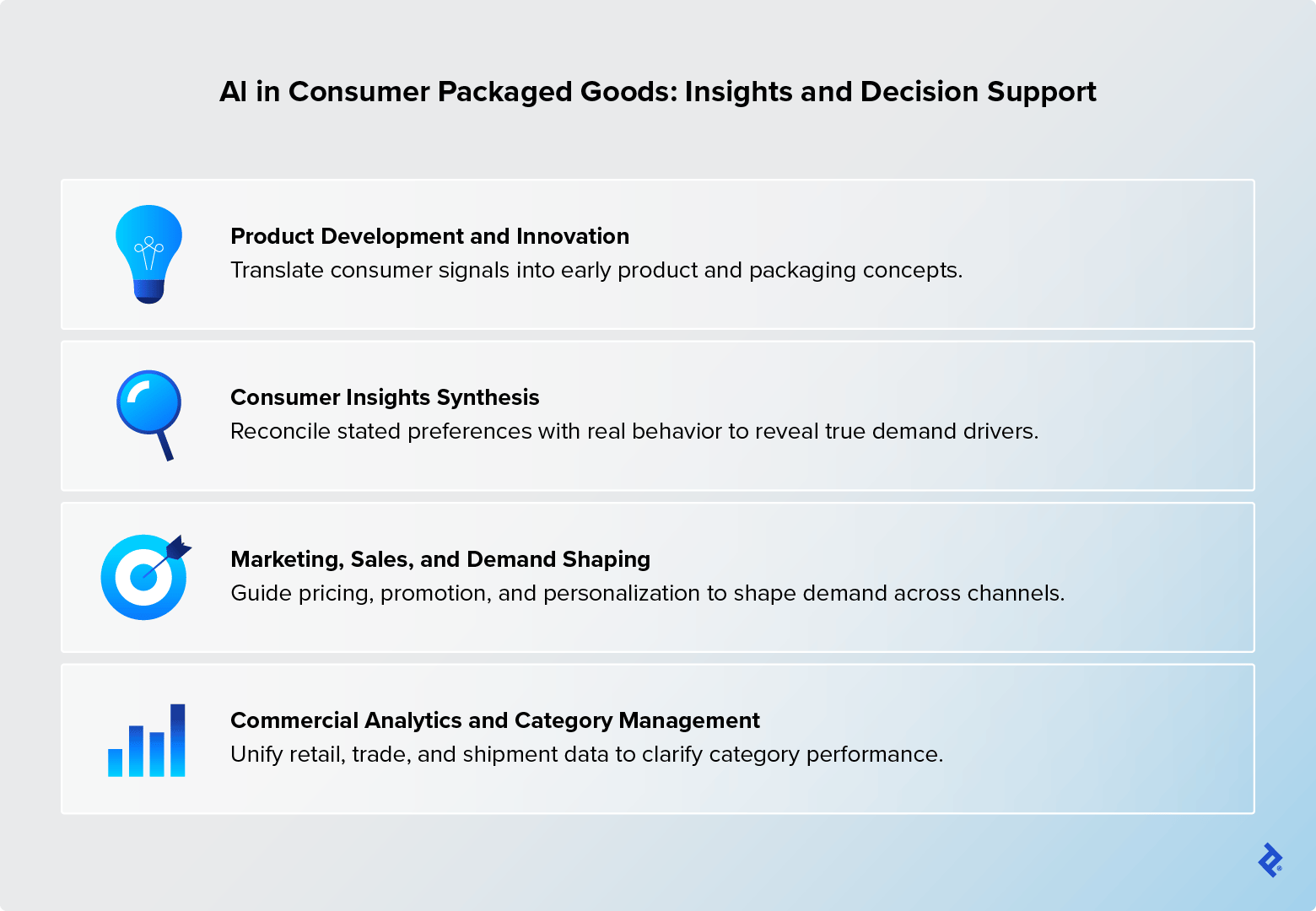
At the front end of product innovation, predictive models mine social sentiment, panel data, and retailer feedback to identify emerging consumer needs. PepsiCo, for example, has used AI to track trends in the food-influencer space as flavor inspiration.
Across consumer insights and commercial decision-making, we see companies turning to AI to reconcile what customers say with what they actually buy, historically one of the most persistent challenges in CPG. By triangulating survey responses, behavioral data, retailer point-of-sale feeds, and internal shipment records, AI systems surface more reliable indicators of demand drivers and pricing elasticity.
This same logic extends into AI in marketing and sales, where models guide segmentation, promotion planning, and resource allocation. Coca-Cola, for instance, has partnered with Adobe to standardize AI-driven personalization across global marketing teams, while also using generative AI to accelerate creative production for marketing campaigns. This reflects a broader industry trend: A 2024 Salesforce study found that 38% of CPG companies use generative AI in marketing and 32% in sales, though adoption remains uneven.
Finally, AI is strengthening commercial analytics and category management by unifying data that historically lived in separate systems (such as retailer point-of-sale feeds, trade promotion results, panel insights, and distributor data) into a coherent view of channel performance. The result is faster trend detection, more informed retailer collaboration, and better-informed investment decisions.
Agentic AI and Intelligent Automation in CPG
More recently, CPG companies have begun embedding agentic and automation-oriented AI systems directly into day-to-day workflows, such as logistics and replenishment optimization. While these aren’t the glamorous, headline-grabbing use cases that promise to “reinvent marketing” or “redefine consumer insight,” they’re capable of producing incremental operational gains that generate real ROI, particularly in workflows where faster, more reliable execution directly affects costs, service levels, and margins.
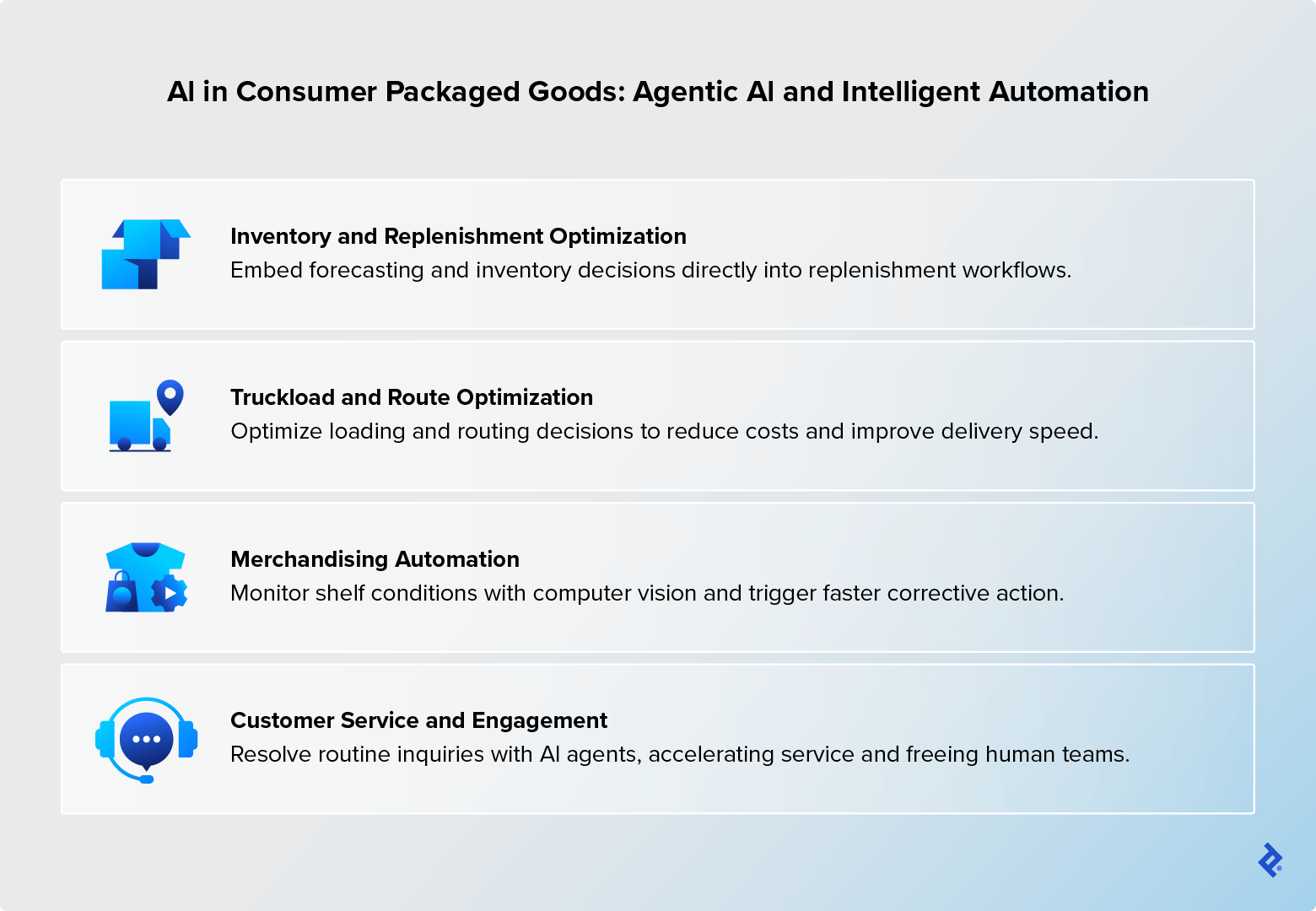
In inventory and replenishment, predictive models refine demand forecasts while simulations test “what-if” scenarios before supply chain disruptions occur. Agentic systems can automatically rebalance inventory or surface prioritized recommendations within planning workflows. General Mills, for example, partnered with Palantir to deploy an AI platform that flags supply chain risks and generates human-validated actions, contributing approximately $14 million in annualized savings. The impact came not from algorithmic novelty alone but from embedding intelligence directly into execution processes with clear ownership of exceptions.
Similar patterns appear in transportation and merchandising. AI systems now support teams on the loading dock by determining how to use the final feet of trailer space and optimizing delivery routes. In stores, computer vision tools assess shelf conditions and planogram compliance in near real time. Coca-Cola Andina, for instance, increased audit accuracy from roughly 80% to more than 95% while cutting in-store audit time nearly in half. These may seem like small, everyday decisions, but multiplied across thousands of shipments and hundreds of retail displays, they become a meaningful source of margin expansion and operational efficiency.
Customer service is following the same trajectory. AI agents now handle a growing share of routine inquiries, accelerating resolution times and freeing human representatives to focus on higher-value interactions. According to Salesforce’s 2025 Consumer Goods Industry Insights report, 47% of consumer goods organizations already use AI agents for customer service, and another 34% plan to adopt them within two years. As with other operational use cases, the advantage lies in redesigning workflows so human and machine capabilities reinforce one another.
Why Traditional Operating Models Fail for AI
While CPG leaders like Coca-Cola, General Mills, and PepsiCo are demonstrating real success with both operational and strategic AI use cases, scaling that success across the enterprise remains difficult for many organizations. In practice, this is rarely due to a lack of technology or isolated tooling decisions. As highlighted in discussions at NRF 2026 and in industry forums hosted by our Consumer Products and Services team, operational structure has become a primary constraint on AI innovation.
These challenges often surface as familiar problems:
- Data fragmentation: Unlike digital-native industries, most CPGs operate in an ecosystem where the most valuable data (such as purchase behavior and loyalty signals) sits outside their direct control. Retailers and distributors often have the clearest access to execution data, while manufacturers are left stitching together partial views from first-party sources, third-party providers, and delayed reports.
- Build-versus-buy uncertainty: Core technology and data partners such as Salesforce, Oracle, and NIQ (formerly NielsenIQ) are embedding AI directly into their platforms, as are major retailers like Walmart. While prebuilt AI solutions can accelerate early progress, overreliance on them can limit flexibility over time, constraining an organization’s ability to experiment beyond predefined capabilities or negotiate with partners.
- Rigid governance: Centralized governance models, designed to manage risk and ensure compliance, consistently slow AI initiatives to a crawl. New use cases can spend months moving through layers of legal, security, procurement, and IT review before a single model is deployed.
Together, these constraints point to the need for a different approach, one that treats operating model design as central to AI success. Traditional approaches to deploying AI assume success depends on securing a small number of highly specialized experts and fitting them into existing workflows. In practice, even when CPG companies attract strong AI specialists, those individuals often struggle to create impact inside operating models built for slower, linear decision-making, leading to stalled initiatives and rising talent churn.
Conversely, when CPG organizations adopt the right team structures and deploy adaptive talent against discrete problems at each phase of an AI initiative, they can move beyond these roadblocks by aligning data, tools, and governance in service of execution.
Strategic Framework for Scaling AI With Adaptive Teams
We’ve developed a framework for building effective AI teams for consumer goods organizations, grounded in the six core principles of Toptal’s adaptive talent model. Rather than a linear sequence, these principles operate as a continuous loop that aligns AI initiatives around business outcomes, deploys the right skills at the right time, and learns from results to improve the next cycle.
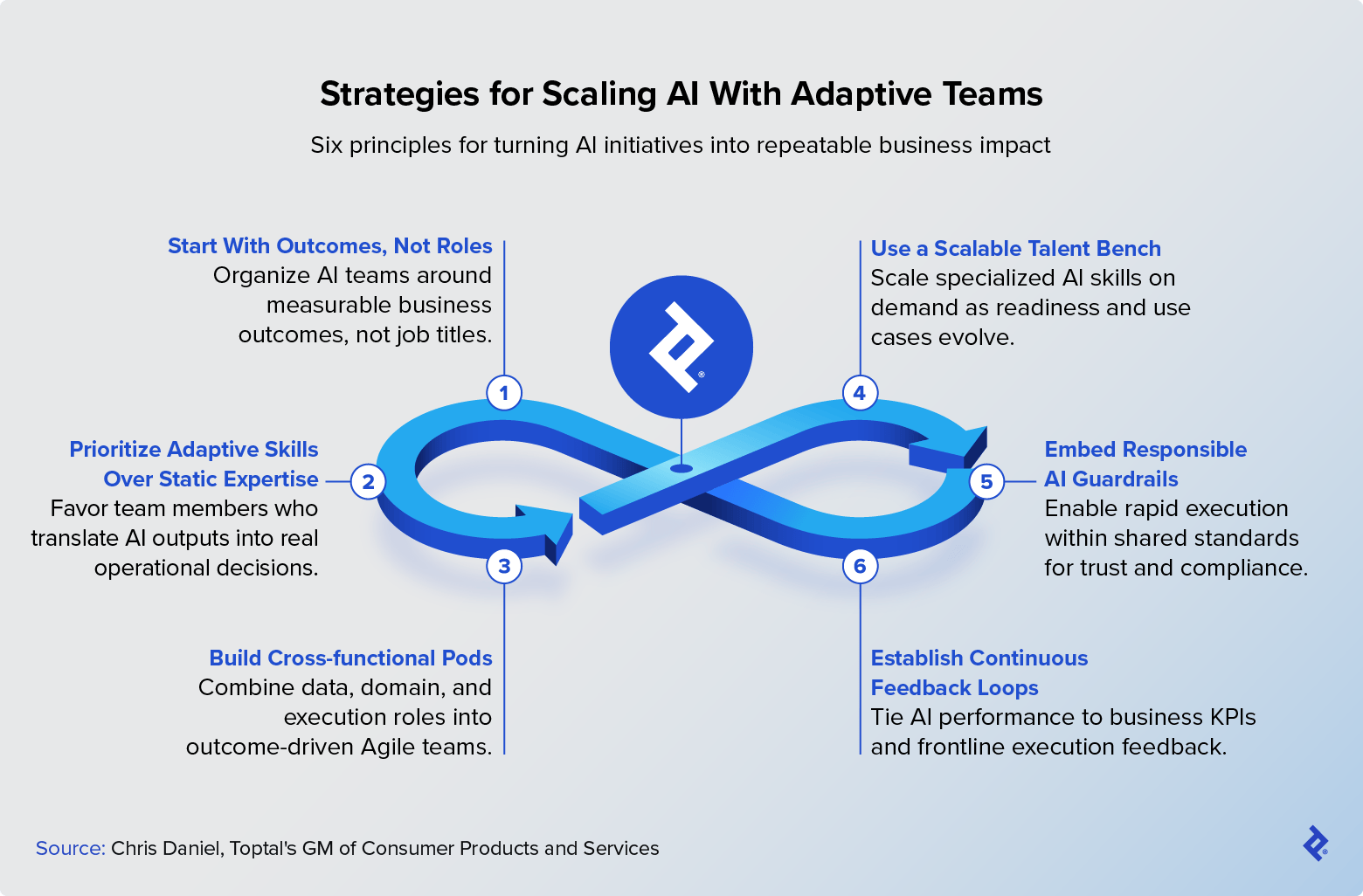
1. Start With Outcomes, Not Roles
Build your AI teams around the specific outcome your business is trying to achieve, whether that’s improving forecast accuracy, optimizing promotions, increasing personalization lift, or squeezing a few more pennies of margin out of every truckload. While data scientists and machine learning engineers are often essential to these initiatives, their work only delivers value when it is anchored to an operational target and embedded into the workflows where decisions are made and executed.
In practice, this means staffing around outcome-driven initiatives such as:
- A computer vision program for merchandising.
- A supply chain efficiency or truckload optimization initiative.
- A predictive demand engine that can be embedded into planning cycles.
Defining concrete outcomes, along with the metrics that will prove them, clarifies ownership and prevents a common industry problem: bringing AI specialists into the organization without a clearly defined mission or supportive data infrastructure. An outcome-driven approach ensures teams are deployed where impact is most achievable, and where data and workflows are ready to support real value creation.
Action: Require a clear, time-bound outcome statement (e.g., a 90-day target) before approving any AI hire or initiative. To support this shift, consider reallocating a defined portion of your data science budget (e.g., 20%) toward outcome-aligned, mission-based projects.
2. Prioritize Adaptive Skills Over Static Expertise
Our model for building adaptive teams closes the gap between insight and action by prioritizing hybrid, translational skills over narrow technical specialization. Adaptive teams require specialists who understand how AI systems work and how decisions are actually made in CPG organizations. They can interpret model outputs, challenge assumptions, and embed intelligence directly into planning cycles, commercial workflows, and execution rhythms.
In many organizations, responsibility for AI adoption is implicitly divided:
- Business product owners define the long-term product strategy.
- IT product owners ensure the product delivers maximum value to users, customers, and the business.
Adaptive team structures collapse this handoff, reducing coordination overhead and increasing trust in AI-driven decisions.
While it can be challenging to find team members who blend these capabilities, you have far more options when you adopt remote or hybrid team arrangements or partner with a specialized technology and professional services staffing firm to bring in skilled contract talent. Expanding beyond local talent pools makes it easier for you to access individuals who understand both the technology and the commercial realities of CPG and who can help define the path forward.
Action: Treat AI translation as a first-class capability. Ensure every artificial intelligence initiative has clear ownership for adoption, not just model performance, and reward teams based on business impact, not technical output alone.
3. Build Cross-functional Pods
Even with the right team members in place, many AI initiatives stall because work is still organized around functional silos rather than shared outcomes. Data scientists sit in analytics teams, planners sit in supply chain, and commercial leaders sit elsewhere, forcing AI insights to travel across handoffs before they influence real decisions.
Adaptive organizations replace this model with cross-functional Agile pods that are designed around a specific decision or outcome. Each pod brings together the people required to move from data to action, combining technical expertise, business context, and operational authority in a single team.
A pod focused on AI-powered demand planning and forecasting, for example, might include:
- Data scientists and AI engineers who build and maintain demand-forecasting models and pipelines.
- Supply chain planners and revenue management leaders who translate signals into production and allocation decisions.
- Commercial or retail-facing stakeholders who validate assumptions with execution data.
This structure reduces coordination overhead, shortens feedback loops, and helps AI systems earn trust through repeated, visible impact. Instead of waiting months for approval or alignment, teams can prove value in weeks and then scale successful patterns across the organization.
Action: Break the AI silo. Embed data and AI talent directly into the functions where their outputs drive day-to-day decisions, while maintaining lightweight central standards for data, security, and responsible AI.
4. Use a Scalable Talent Bench to Match Readiness
Because AI requirements evolve quickly, and many skills are highly specialized, your permanent teams may struggle to fill capability gaps as they arise. To stay nimble, it’s important to maintain a scalable talent bench that blends:
- Core full-time employees in data, engineering, and product who anchor your long-term capability.
- On-demand specialists in areas like machine learning, prompt engineering, computer vision, or advanced analytics who can be activated for specific initiatives.
This model avoids one of the most common pitfalls in CPG: hiring highly advanced AI talent long before your organization has the data foundations, cloud infrastructure, or defined use cases needed to support meaningful work. With a flexible bench, you can scale expertise in sync with readiness, expanding during experimentation or new program launches, and contracting as systems mature.
Over time, the key question shifts from “How many AI specialists do we employ?” to “How quickly can we activate the right expertise against a new outcome?” That shift will enable your organization to move faster than traditional hiring processes allow and maintain momentum even as AI technologies, data partnerships, and priorities evolve.
Action: Build a dynamic talent bench. Identify your next high-value AI use cases and premap the specialized skills they will require. Then source top talent on demand rather than committing to permanent roles upfront.
5. Embed Responsible AI Guardrails Without Slowing Teams
As AI becomes embedded in everyday CPG decisions, the risk profile intensifies. Responsible AI is no longer a future concern or a compliance checklist; it becomes a prerequisite for scale. Yet many CPG organizations centralize oversight so tightly that progress grinds to a halt.
Adaptive CPG organizations take a different approach. Rather than funneling every AI initiative through a single approval body, they separate guardrails from execution:
- Shared platform teams define standards for data privacy, security, model transparency, and acceptable use.
- Product teams, meanwhile, operate within those guardrails, moving quickly while remaining compliant.
Organizations should also anticipate greater scrutiny. Independent AI audits, analogous to financial audits, are likely to become standard over time. Companies that treat responsible AI as part of their operating model, rather than a separate compliance function, will be far better positioned to scale AI across brands, categories, and markets without costly rework.
Action: Define lightweight, reusable AI guardrails. Then empower your Agile pods to operate within them, turning governance into an enabler of responsible experimentation.
6. Establish Continuous Feedback Loops
Your adaptive teams should create systems that learn from every deployment. It’s important to conduct regular model reviews to tie AI outputs to business KPIs such as revenue lift, margin improvement, service levels, or promotion ROI, while your operational teams provide frontline feedback on what worked in stores, on trucks, or in service channels. These insights will allow your pods to refine use cases, data pipelines, and even build-versus-buy decisions based on real-world performance rather than assumptions.
Over time, these loops also serve as proving grounds for both talent and technology bets, helping identify “no regrets” investments and allowing teams to change course when experiments fail to generate value.
Action: Formalize learning loops. Require every AI initiative to define success metrics upfront; review performance on a fixed cadence; and feed operational feedback directly back into model and team design decisions.
The Future of AI in the CPG Industry: A Durable Advantage
The CPG leaders we work with are increasingly clear on one thing: The future of AI in CPG will be shaped by how teams, data, and governance are structured to turn insight into execution. The challenge is no longer access to technology but the ability to embed AI into everyday decision-making in environments defined by fragmented data and complex partnerships.
We’ve found that the companies making real progress are not betting everything on a single platform or breakthrough use case. Instead, they are building operating models that can evolve. They are scaling automation where it reliably improves efficiency and refining capabilities as retailer expectations and consumer behaviors shift. In practice, this means strengthening first-party data foundations, establishing responsible AI guardrails, and redesigning teams to empower adaptive talent who can translate business problems into deployed solutions.
Ultimately, AI deployment is not a one-time transformation for CPG organizations. It is an institutional capability. Organizations that treat it that way, combining disciplined execution with adaptive team structures and continuous learning, will sustain advantage over time. In a sector without a fixed AI playbook, durable advantage belongs to companies that can convert intelligence into action, repeatedly and at scale.
Have a question for Chris or his Consumer Products and Services team? Get in touch.
Authors

About the author
Chris is Toptal’s GM of Consumer Products and Services. A seasoned executive who has held leadership roles in technology startups and global consultancies like EY, Nielsen, and Capgemini, Chris has built innovative partnerships with Google Cloud, AWS, and Microsoft Azure. Chris has a bachelor’s degree in engineering and math from the University of Illinois Urbana-Champaign and a bachelor’s in physics from Illinois State University.
PREVIOUSLY AT

About the author
Matt is Toptal’s Business Strategy and Finance Consulting Practice Lead. He has held senior leadership roles at Cognizant, Accenture, Deloitte, PwC, and IBM, advising enterprise clients on digital transformation and AI-driven strategy. Matt has led multimillion-dollar engagements and partnered with executive teams across retail and consumer industries. He holds a bachelor’s degree in economics from Denison University.
PREVIOUSLY AT