
Business Model Innovation: Driving Resilience When Disruption Is the Default
Toptal’s Senior Client Solutions Advisor explores how leading companies like SAS and ServiceNow successfully updated their business models—and shares advice for other organizations looking to do the same.

Toptal’s Senior Client Solutions Advisor explores how leading companies like SAS and ServiceNow successfully updated their business models—and shares advice for other organizations looking to do the same.

Michael is a management consulting and client advisory leader with experience at IBM, PwC, Cognizant, and Toptal. Over the course of his career, he has designed and directed consulting practices, including serving as head of consulting for the Americas at Cognizant, where he advised leaders across sectors such as telecommunications, media, and energy and utilities. Michael holds a BS in accounting from St. Joseph’s University and has completed advanced management programs at Harvard, Columbia, and Emory universities. He also serves as a guest lecturer at Columbia University and Baruch College.
Previously At


Disruption now defines the business environment, fueled by supply chain uncertainty, shifting labor markets, and geopolitical instability. In a September 2025 survey by Accenture, 90% of C-suite leaders say the pace of change has accelerated since January 2025, and 84% expect the pace to increase further. Leaders must rethink business model design to compete in a world where conditions change faster than traditional planning cycles can accommodate.
This article explores practical ways for businesses to manage resources, connect with customers, develop talent, and work with partners to create and deliver value in today’s volatile landscape.
Why Business Model Innovation Is a Strategic Imperative
Supply chain stress remains above pre-pandemic levels, reflecting a shift from one-off shocks to an environment shaped by geopolitical tensions, weather-related disasters, and cyber threats that no quarterly plan can absorb. Corporate earnings calls increasingly revolve around volatility and resilience, and in response, 63% of global supply chain executives are investing in automation and AI to enhance agility, and 61% are retraining workforces to navigate uncertainty, according to a recent survey by EY.
This is an enormous shift from the traditional business environment of the past, when firms focused on efficiency, scale, and predictability. Just-in-time inventory systems, centralized supply chains, and long-term planning worked when disruption was episodic, but that model starts to break when instability becomes constant. Even newer, platform-based strategies such as ecosystem models, subscription services, and data-driven personalization were built on an assumption of predictable supply chains, forecastable customer behavior, and slow regulatory change.
Today, many platform-based businesses face saturated markets, supply chain constraints, and mounting regulatory pressure. What’s more, subscription models are strained by churn, and AI strategies, still in their early stages of adoption, are complicated by data quality, talent gaps, and organizational misalignment. Meanwhile, geopolitical tensions, evolving trade relationships, and weather-related crises continue to disrupt the status quo.
As a strategy and innovation leader at Cognizant and IBM, I helped leading organizations fundamentally rework their operations to keep pace with uncertainty and market evolution. Now, as the Senior Client Solutions Advisor at Toptal, I help companies redesign their operating models, build real-time visibility into performance, and enable agile decision-making. What I’ve seen across industries is that the issue is less about execution and more about flawed assumptions, chief among them that disruption can be planned around rather than planned for.
The Importance of Optionality in Business Model Innovation
In this new environment, responsiveness must become a core design principle. Business models must function as adaptive systems, capable of sensing change, reallocating resources, and evolving in real time. Companies at the forefront of business model change can achieve productivity gains 1.5% to 8.5% higher than those that fall behind, according to a 2024 study of 18,000 global companies by PwC.
Modern organizations are abandoning fixed, long-range plans in favor of living strategy models. These iterative, data-driven cycles blend strategic intent with constant reevaluation. This strategic optionality allows companies to make faster decisions while retaining the flexibility to pivot as conditions change.
In practical terms, optionality means designing a business to keep several viable strategic paths open. That might involve modular product architecture, flexible partner agreements, or workforce models that support rapid reconfiguration.
Companies that build optionality into their business strategy are able to act more quickly when conditions shift because they are working from less rigid scenarios and capabilities. Instead of scrambling to respond, optionality allows companies to move forward with confidence because the choices they are making in real time were considered in advance.
How to Build Optionality Into Your Business Model
To create a business model that can adapt at speed, every structural layer of the enterprise must support change. Four places to start:
Reengineer Your Cost Structure
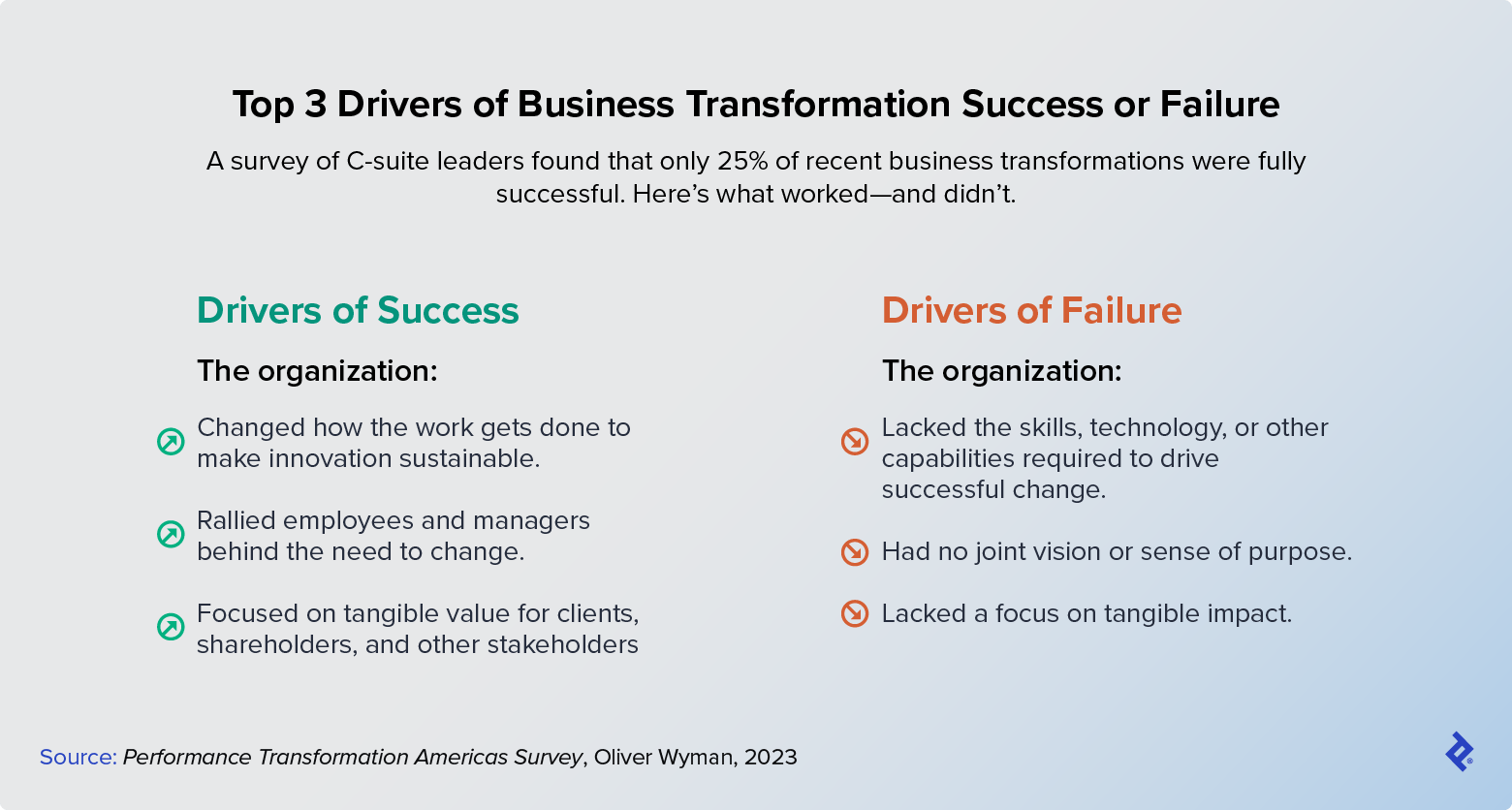
Identify where automation, shared infrastructure, and AI can replace fixed costs with more scalable and responsive systems. Although 100% of C-suite leaders in a 2023 Oliver Wyman survey have attempted a business transformation in the last three years, only 25% achieved all their objectives. Those that succeeded used cost efficiency to fuel growth, and fundamentally restructured operations to sustain the transformation long-term.
Redesign Revenue Models for Variability
Move beyond one-size-fits-all pricing. Combine subscriptions, usage-based fees, and ecosystem-based monetization to capture value across different customer segments and conditions.
Refocus Your Value Proposition
Frame offerings around specific outcomes customers care about. Build personalization and responsiveness into how value is defined, delivered, and measured.
Modernize Your Delivery Infrastructure
Use modular platforms and APIs to make your offerings more composable. Support partner-led delivery models to scale faster and respond to local or specialized needs.
Build Real Partnerships
Shift from transactional relationships to co-innovation ecosystems. Invite partners into your design and delivery processes to extend capabilities and share risk. One of the most important alliances to make right now is with a strategic talent partner that can provide the highly skilled technology services and change management experts needed to drive successful transformation. More than 40% of C-suite leaders in Accenture’s 2024 Pulse of Change survey said skill gaps were one of the top three blockers in their companies’ ability to respond to change.
On-demand access to highly specialized technical talent is particularly important as organizations strive to unlock the value of new technologies. In a 2023 survey of senior corporate leaders by KPMG, executives said technological capability gaps represented their biggest challenge during transformations—and nearly every business process or growth initiative now has a technology element.
Three Shifts High-performing Companies Are Making Now
Business model innovation today is about building systems that can adapt to many possible futures. These are three strategic changes I see leading organizations putting into practice:
1. Make Strategy a Daily Discipline
Strategy should not be a one-off exercise or something revisited only at quarterly off-sites. Planning must become part of the daily rhythm of decision-making. The framework outlined in the graphic below is designed for this. It gives leaders a way to act quickly when new pressures or opportunities emerge, without abandoning rigor or alignment.
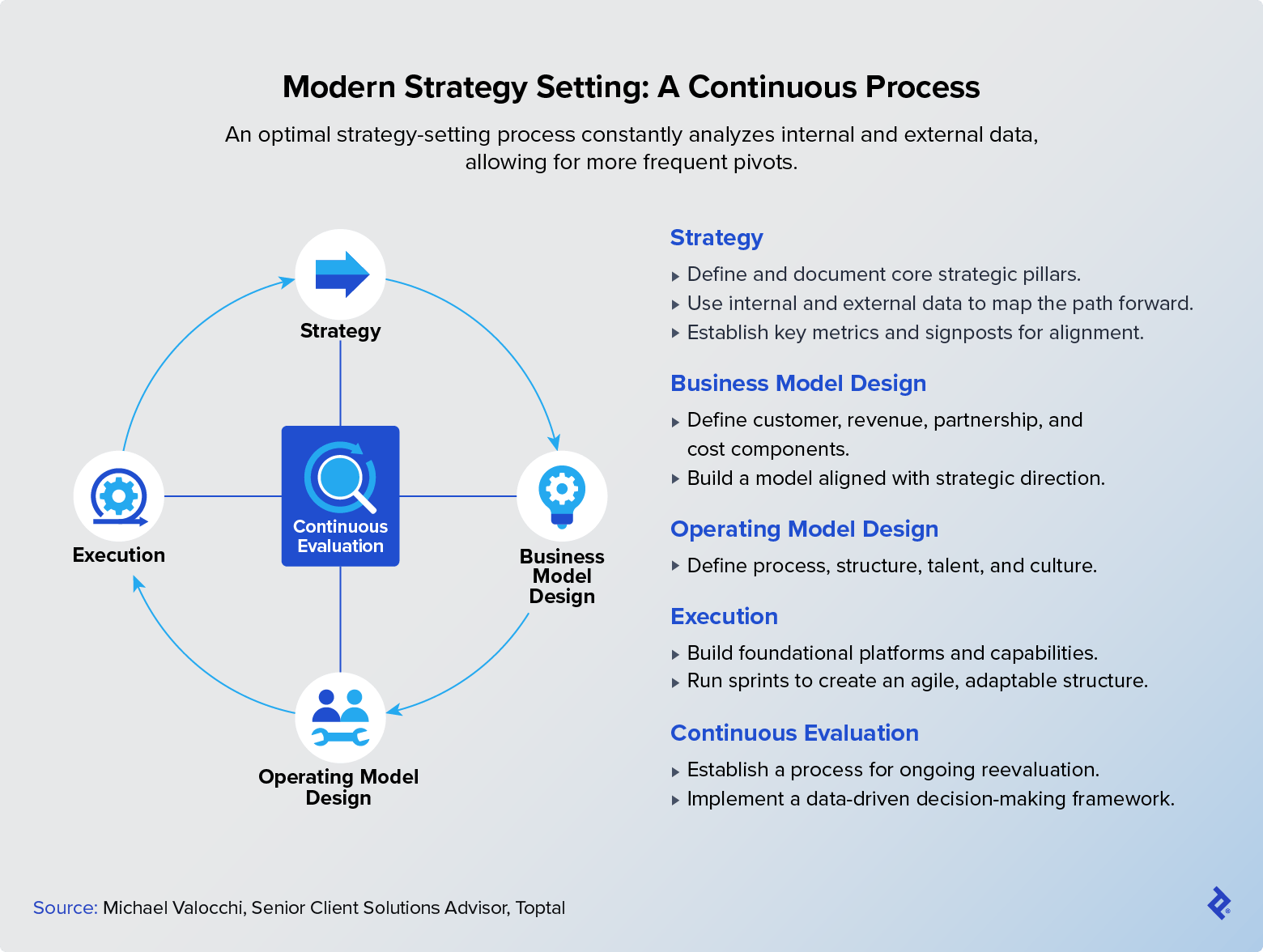
One organization I worked with adopted a simple but powerful decisioning model that gave teams a shared language and helped reduce bias in high-stakes moments. They called it Facts, Alternatives, and Decision:
- Facts: All discussions began with a common, trusted dataset. Relying on unified data sources kept teams aligned and eliminated confusion from conflicting inputs.
- Alternatives: From there, the group laid out multiple paths forward. Exploring viable options early clarified trade-offs and surfaced better ideas without teams getting stuck in endless testing.
- Decision: The group committed to a course of action with clear ownership and timelines. Because everyone understood the process, there was less second-guessing and faster execution.
The beauty of this kind of structure is its simplicity: It can live within everyday operations and does not require formal meetings or special reviews. When built into the regular workflow, it helps organizations stay aligned, responsive, and focused without losing discipline.
2. Rebuild Around a Platform Mindset
Some platform models are now strained by trade barriers and shifting regulations, but platform thinking still holds power when it’s grounded in architectural clarity, operating flexibility, and a sharp understanding of where and how value accumulates. Standout companies like Stripe and Shopify, for example, are still thriving thanks to their adaptable, open systems.
These companies don’t just chase network effects or lean on subscription revenue. Instead, they design platforms where developers and partners—think app creators or merchants—can seamlessly integrate and build custom solutions, adding value without being trapped in proprietary ecosystems. Stripe’s APIs let businesses tailor payment systems, while Shopify’s tools empower merchants to scale without restrictive contracts.
These companies also foster relentless innovation internally, aligning teams across development, sales, and delivery to iterate quickly and respond to shifting customer needs. This agility lets them stay ahead in markets where rigid models falter.
3. Establish the Foundations for Ongoing Adaptation
I’ve worked with companies that invested heavily in new business models but struggled to bring them to life. For these organizations, strategy lived in one part of the business, while delivery systems, incentives, and team structures remained rooted in the old model. In my experience, companies that adapt well invest in resilient operating models, reskilling, workforce flexibility, and supporting culture change.
Resilient Operating Frameworks
Durable structures allow organizations to act faster when conditions shift by implementing superprocess frameworks that cut across silos and give clear ownership of outcomes, rather than following rigid org charts.
Continuous Reskilling
Skills are decaying faster than ever. Some widely accepted statistics put the current half-life of general skills at five years, while the lasting power of technical skills may be as short as two years. Companies that thrive make reskilling part of their normal operating rhythm, not a one-off intervention.
Flexible Workforce Structure
Many of the most adaptive companies build dynamic, capability-based models, allowing them to bring in specialized expertise when and where it’s needed. On-demand talent partners are increasingly part of this approach, helping companies augment internal teams with vetted experts for high-impact initiatives. I’ve seen large manufacturing firms use on-demand talent to support corporate strategy, tapping senior professionals and cross-functional talent to guide planning, transformation, and mergers and acquisitions work without needing to build those capabilities in-house. This workforce model provides agility without long-term overhead.
Shifting Company Culture
One of the biggest blockers to adapting is a company’s inability to let go of past success. Nostalgia slows down action. Leaders need to create an environment that respects institutional heritage but doesn’t cling to it. Codifying a deliberate culture—three to five attributes that shape behavior and decision-making—helps teams act with clarity, especially under pressure.
3 Business Model Innovation Case Studies
Instead of fine-tuning offerings or launching incremental services, leading companies are rethinking the fundamentals and redefining how they generate revenue, build partnerships, and deliver value. Let’s take a look at how ServiceNow, SAS, and CenterPoint Energy have tackled this transformation.
The Reinvention of ServiceNow
By the mid-2010s, ServiceNow had achieved success as a leading SaaS platform for IT service management (ITSM), streamlining help-desk operations and incident workflows for enterprise clients. But the model that once differentiated the company was becoming a constraint. As digital transformation took hold across industries, the limitations of traditional ITSM tools became more pronounced. Organizations faced mounting complexity, siloed departments, rising service expectations, and an urgent need to deliver more automated, integrated experiences across IT, HR, finance, security, and customer operations.
This growing demand for enterprise-wide service orchestration created an inflection point. Legacy ITSM players that failed to adapt began to lose relevance, unable to meet expectations for agility, AI-driven insights, and low-code extensibility. ServiceNow recognized this shift early and began a deliberate transformation, expanding its platform architecture to support a broader range of workflows, and redesigning its go-to-market approach around cross-functional value delivery.
The shift was not cosmetic. Internally, the company reorganized teams, formed deeper partnerships, and repositioned itself from a tool vendor to a strategic enterprise platform. Its technology evolved to support workflow automation across departments, leveraging machine learning and low-code customization to empower rapid deployment and continual optimization. The result was a new kind of enterprise operating system, designed to unify service delivery across the business.
The impact of this reinvention has been clear. ServiceNow experienced sustained uptick in revenue and customer adoption, growing its annual revenue from just under $2 billion in 2017 to nearly $11 billion by the end of 2024. In Q2 2025 alone, it reported $3.1 billion in subscription revenue. Growth among large enterprise customers has surged, with over 30% annual growth in high-value accounts.
Business Model Innovation at SAS
For more than five decades, SAS has been a cornerstone of enterprise analytics, helping organizations make sense of complex data long before terms like “big data” and “AI” entered the mainstream. But as the data landscape expanded and cloud-native competitors gained traction, SAS faced a critical challenge: how to modernize without sacrificing the reliability and trust it had built in sectors like finance, healthcare, and government.
Rather than pursue aggressive reinvention, SAS took a strategy of continuous, deliberate innovation. Central to its transformation is the expansion of SAS Viya, the company’s flagship data and AI platform, which now anchors the organization’s shift from legacy analytics to cloud-native, AI-driven solutions. SAS has invested $1 billion over several years to strengthen its cloud portfolio and build trustworthy generative AI capabilities tailored to complex, regulated industries. Strategic partnerships with Microsoft Azure and Nvidia have further advanced this effort, giving customers scalable deployment options and access to high-performance computing.
Viya now supports the full AI life cycle with productivity-boosting tools like Viya Workbench and Viya Copilot and integrations with Python, R, and Azure. These moves reflect a broader shift to meet enterprise needs for speed, scalability, and trust in cloud environments. This evolution also marks a change in the SAS business model, from primarily license-based and on-premises deployments to a cloud-first, subscription-driven approach that prioritizes continuous delivery and industry-specific AI solutions.
The results of this transformation are significant: In 2024, SAS recorded more than $3 billion in global revenue. Viya sales grew by 24%, and sales of Viya 4 (its most modern offering) grew 56%. Managed Cloud Services posted 16% growth, marking the fifth straight year of double-digit cloud expansion. Analyst recognition remains strong, with SAS ranked a leader in 47 separate evaluations across domains like AI, machine learning, fraud detection, and decisioning. The company’s long-term focus and self-funded structure fuel a balance of modernization and preservation of its trusted brand.
Long-term Investments at CenterPoint Energy
CenterPoint Energy, a utility based in Houston with more than 80 years of history, has undertaken a strategic shift to modernize its value delivery. Traditionally focused on infrastructure management, the company has adopted a new model that relies on digital tools, customer-facing technologies, and long-term investment in resilience and scalability.
The transformation began with the deployment of smart-grid technologies, including advanced meters, automated switches, and real-time distribution management systems. These upgrades improved outage response and grid reliability, helping customers avoid 100 million outage minutes. The company also introduced AI-driven systems to support predictive maintenance and load forecasting, improving operational efficiency and service quality. In parallel, CenterPoint restructured its capital strategy to support long-term growth and demand. In 2024, it increased its 10-year capital plan to more than $53 billion, with $4 billion allocated to new investments in Texas alone.
CenterPoint’s approach illustrates how a legacy utility can evolve into a more adaptive and performance-oriented business. Through a combination of infrastructure modernization, data integration, and strategic investment, the company is redefining its role in a rapidly changing energy landscape.
Leading Through the Permanent Storm
I’ve worked with leaders who tried to manage disruption by containing it, treating it like a phase to push through before returning to business as usual. That approach rarely works. A far more powerful approach: learning to treat disruption as a constant feature of the landscape, not a temporary detour.
In my experience, the most resilient teams aren’t the ones with the flashiest strategies or the most advanced tech. They stay close to the ground, ask better questions, and make decisions with discipline and intent. They know what to protect, what to redesign, and when to let go of old assumptions. Clarity is the key to moving faster and with more confidence.
The task for leaders now is to build that kind of clarity into the organization itself. Design processes that absorb change rather than stall in front of it. Create a culture that treats ambiguity as something to explore, not avoid. And make space—structurally and psychologically—for your teams to test, learn, and adapt without waiting for perfect conditions.
This isn’t about chasing trends. It’s about becoming the kind of organization that remains sharp and capable even as the landscape keeps shifting.
Have a question for Michael or his Management Consulting team? Get in touch.

Michael Valocchi
About the author
Michael is a management consulting and client advisory leader with experience at IBM, PwC, Cognizant, and Toptal. Over the course of his career, he has designed and directed consulting practices, including serving as head of consulting for the Americas at Cognizant, where he advised leaders across sectors such as telecommunications, media, and energy and utilities. Michael holds a BS in accounting from St. Joseph’s University and has completed advanced management programs at Harvard, Columbia, and Emory universities. He also serves as a guest lecturer at Columbia University and Baruch College.
PREVIOUSLY AT