
Consulting Industry Trends 2026: Evaluating Consulting Partners in the Age of AI
As AI reshapes the consulting industry, company leaders must rethink how they choose advisory partners. Use these five considerations to identify firms built for today’s business landscape.

As AI reshapes the consulting industry, company leaders must rethink how they choose advisory partners. Use these five considerations to identify firms built for today’s business landscape.
Authors

Matt is Toptal’s Business Strategy and Finance Consulting Practice Lead. He has held senior leadership roles at Cognizant, Accenture, Deloitte, PwC, and IBM, advising enterprise clients on digital transformation and AI-driven strategy. Matt has led multimillion-dollar engagements and partnered with executive teams across retail and consumer industries. He holds a bachelor’s degree in economics from Denison University.
Previously At




Barbara is a management consultant with expertise that spans cost optimization, process improvement, procurement transformation, and operational strategy. She has advised private equity firms, founder-led businesses, and Fortune 500 companies across manufacturing, energy, and infrastructure sectors, delivering measurable EBITDA impact for clients. Barbara holds an MBA from the Kellogg School of Management at Northwestern University.
Previous Role
Advisory DirectorPreviously At



The consulting industry has reached a structural inflection point. AI, automation, and productization are reshaping how consulting services are delivered and scaled, prompting firms to restructure their operations and invest in AI-enabled systems. McKinsey, for instance, has reduced its overall headcount by more than 10% in recent years while simultaneously augmenting its capabilities with tens of thousands of AI agents.
Collectively, we’ve spent decades supporting clients at Cognizant, Accenture, PwC, and Deloitte, and now provide management consulting services at Toptal. Over that time, we’ve seen the industry evolve through several waves of technological change, but we have never seen it transform as quickly or as fundamentally as it is today.
These changes have profound implications not only for consulting firms but also for the organizations that hire them. When consultants operated under relatively uniform staffing models and predictable, labor-driven economics, reputational signals often served as a practical shortcut for business leaders selecting a partner. Now, more than ever, leaders must evaluate how firms operate, not just how prestigious their brand is.
In this article, we explain why traditional consulting models are breaking down and how new operating architectures redefine value. We also present five practical considerations to help business leaders identify the right consulting partner in today’s market.
Downloadable Guide: We’ve compiled the five considerations and their accompanying evaluation questions into a practical reference guide. Use this downloadable PDF to assess consulting partners and apply these criteria consistently across engagements.
Consulting Industry Trends Reshaping How Firms Operate
The traditional management consulting model was typically built on a hierarchical structure known as a leveraged staffing pyramid. In most engagements, large groups of junior analysts conducted research and analysis, a smaller group of managers synthesized the findings, and partners translated the insights into recommendations for clients. The model was labor-intensive, with the firm’s success tied directly to headcount and billable hours.
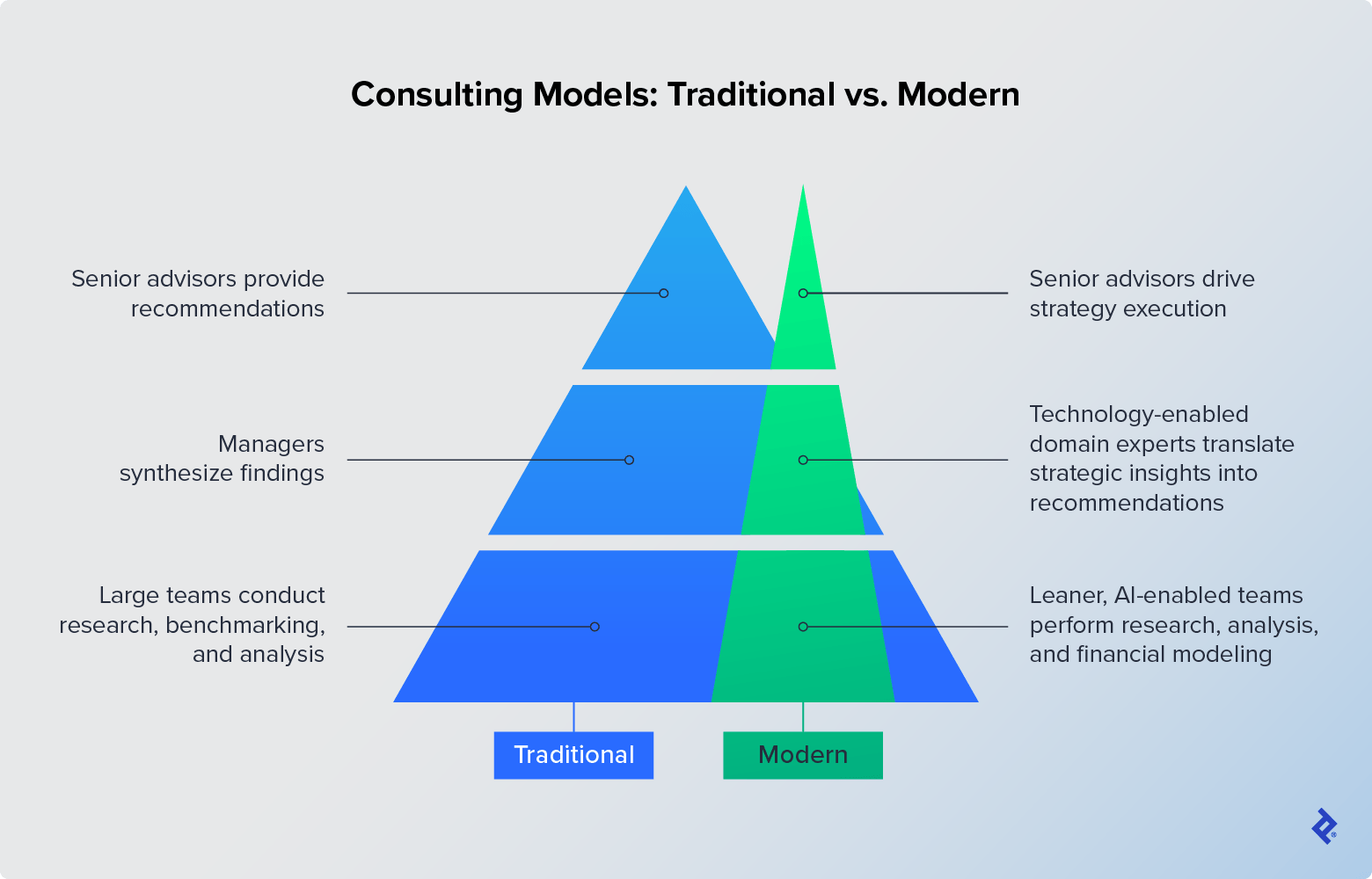
Because that architecture was broadly consistent across firms, selecting a consultancy often followed a predictable strategy. Business leaders could evaluate brand reputation, partner credentials, and prior client work as reasonable proxies for quality. Those assumptions are breaking down, reflecting a set of core consulting industry trends that are redefining how firms operate and deliver value:
- Consulting is shifting to product-led delivery models. Consulting has historically depended on large teams to conduct foundational work. Increasingly, expertise is being codified into reusable platforms, tools, and digital assets, while AI automates many underlying tasks, enabling leaner teams to deliver work that once required extensive analyst capacity.
- Capability orchestration is replacing headcount as the engine of growth. As automation reshapes workflow design, the way firms structure and deploy expertise is less uniform across the industry. Firms are differentiating based on how they integrate domain expertise, technical fluency, and intelligent systems into cohesive delivery models.
- The boundary between strategy and execution has vanished. Traditional consulting services often focused on analysis and recommendations, leaving execution to clients or implementation partners. As artificial intelligence becomes embedded in business operations, this boundary is disappearing. Modern firms are building insights directly into technology-enabled workflows and systems.
- Pricing models are evolving beyond time-based billing. When automation compresses weeks of analysis into hours, traditional billing models become misaligned with the value delivered. New pricing approaches, such as outcome-based and subscription models, are emerging to better reflect delivery efficiency and results.
These consulting industry trends are reshaping how firms deliver value and how business leaders should evaluate potential partners. Some firms are reengineering their delivery models, capability structures, and pricing approaches, while others are layering AI onto legacy models without changing the underlying economics. While the former approach is far more likely to generate durable client value, it can often be challenging for leaders to tell which firms truly embrace these new models and which do not.
5 New Considerations for Evaluating Consulting Firms
The five considerations below provide a practical framework for assessing and engaging consulting partners in this new environment. Each consideration highlights a structural shift reshaping the consulting market and includes diagnostic questions to help business leaders evaluate how firms are adapting to these changes.
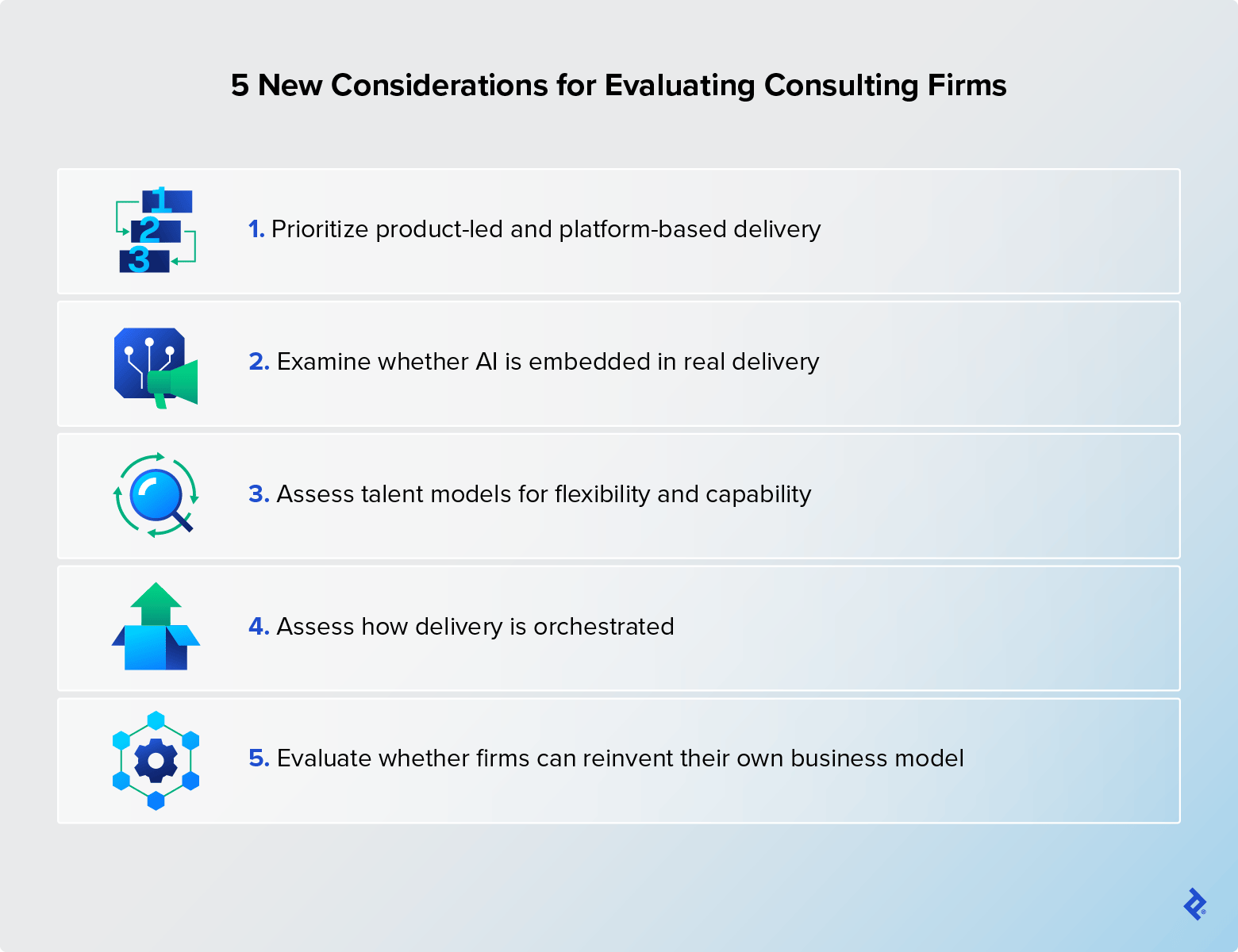
1. Prioritize Product-led and Platform-based Delivery
A defining consulting industry trend is the transition from pure labor-based services toward product-led delivery. Instead of relying solely on bespoke project work, leading firms are codifying expertise into reusable assets and digital systems that accelerate analysis and standardize execution.
This evolution reflects a deeper integration of strategy and technology. Slide decks and workshops are no longer sufficient as the primary outputs of consulting engagements. Instead, strategy is increasingly embedded into digital workflows, automation layers, and scalable platforms that persist long after an engagement ends. As a result, consulting partners are expected not only to generate insights but also to help operationalize them, placing firms far closer to execution than traditional advisory models allowed.
At the same time, the rise of specialized consulting firms with deep expertise in specific areas, such as healthcare or digital transformation, has intensified this shift toward productized services. Boutique players often differentiate through focused platforms or proprietary tools designed for a specific industry or function. Larger firms are investing heavily in building their own internal platforms or acquiring firms with niche capabilities; Accenture’s recent round of acquisitions in the data science and AI space is one example.
For companies assessing consulting partners, the implications are clear. Whether you’re working with a global firm or a specialized provider, product-led delivery is increasingly the norm. Be cautious when a partner is not making meaningful progress in this direction.
How to Evaluate Product-led Delivery
By embedding knowledge into repeatable systems, consulting firms shift from selling time to scaling insight through technology-enabled implementation. However, it isn’t always clear whether the platforms and digital solutions many firms advertise actually shape outcomes.
When evaluating consultancies, therefore, business leaders should consider the following:
- What parts of the firm’s work are delivered through reusable platforms or engineered assets, and what still depends entirely on traditional consulting labor?
- Can the firm demonstrate how those systems have improved delivery speed, cost efficiency, or the consistency and value of outcomes in prior engagements?
- How consistently are these platforms reused across projects and client engagements?
Strong consulting partners should be able to demonstrate how reusable systems have accelerated analysis and improved outcomes across multiple engagements. When firms cannot point to that level of integration, technology is often supporting traditional consulting workflows rather than fundamentally reshaping delivery.
2. Examine Whether AI Is Embedded in Real Delivery
Nearly every consulting firm claims to use automation or AI tools. In fact, Boston Consulting Group, McKinsey, Accenture, and Capgemini have formalized agreements with OpenAI to help deploy and integrate advanced AI systems across enterprise client engagements. For leaders evaluating consulting partners, the meaningful distinction lies in whether those systems materially improve cost efficiency or the quality of outcomes.
In mature consulting environments, generative AI models support scenario analysis and large-scale pattern recognition, compressing timelines and reducing manual analytical work. That alone improves efficiency. But technological evolution becomes even more significant when AI moves from assistance to execution.
Companies should increasingly expect to see AI systems embedded directly in project delivery. Leading firms are beginning to deploy agentic AI systems capable of executing multistep analytical workflows, from business intelligence and data synthesis to modeling and documentation, reducing the time and labor required to produce rigorous analysis for clients. At the same time, digital twin technologies allow firms to build dynamic simulations of client operations, including complex supply chains and manufacturing workflows. These simulations enable teams to test strategic decisions in virtual environments before implementation.
The key consideration for companies is whether their consulting partner has structurally embedded these innovative AI use cases into repeatable delivery processes. Firms that use AI only as a research aid may deliver modest efficiency gains. Firms that embed AI directly into analytical workflows and decision-support systems can accelerate insight generation, test strategies more rigorously, and deliver more consistent business outcomes for clients.
How to Evaluate Real AI Deployment
It can be too easy for consulting firms to present their experimentation with AI as true operational maturity. To evaluate whether a potential partner is using AI in an integrated way that will benefit your company, ask:
- Are AI agents or digital twins deployed in active client engagements, or are they confined to internal pilots and marketing demonstrations?
- Which specific tasks do AI systems perform (e.g., market research, data synthesis, modeling, drafting, monitoring), and how do they alter engagement speed, quality, and staffing structure?
- How does the firm measure the performance impact of AI-enhanced delivery compared with traditional approaches?
- Is AI usage standardized across teams, or does it remain ad hoc and team-dependent?
For clients, the key signal is whether AI meaningfully changes how work is delivered. When AI capabilities are embedded in core workflows and measured against clear performance benchmarks, they can accelerate analysis, reduce delivery costs, and improve decision quality. When they remain confined to demonstrations or isolated pilots, their impact on client outcomes is likely to be limited.
3. Assess Talent Models for Flexibility and Capability
Historically, most consulting firms staffed engagements in a relatively uniform way, with large cohorts of junior analysts forming the foundation of project teams and performing much of the research and modeling. Because most firms relied on similar pyramid structures, differences in team composition were relatively minor.
That uniformity has vanished. While newer approaches to staffing engagements may look like leaner versions of technology-enabled traditional consulting structures, the underlying economics are different. Instead of relying primarily on large cohorts of junior analysts, many firms now place domain specialists at the center of delivery, supported by AI systems that perform much of the foundational analytical work. Where traditional firms scaled through labor, newer models increasingly scale through concentrated expertise and intelligent systems.
Now, more than ever, business leaders should assess the flexibility of each firm’s talent model. Can the firm deploy niche expertise on demand and assemble distributed teams through global networks and remote talent models? Can it integrate domain specialists, technical practitioners, and AI-enabled workflows into a cohesive delivery team? The ability to orchestrate capabilities, rather than simply scale headcount, becomes a central determinant of consulting performance.
How to Evaluate Talent Models
Given the growing variation in how management consultants staff their engagements, business leaders cannot assume that delivery teams will be structured in familiar ways. The following questions can help distinguish firms that have redesigned their talent systems from those that still rely on traditional staffing models:
- Which tasks within the engagement are enabled or performed by AI systems, and how does that change team composition and delivery speed?
- Are domain specialists and technical practitioners embedded directly in delivery teams, or brought in only occasionally as advisors?
- How does the firm access niche expertise that may not exist within its core staff, such as through partner ecosystems, global networks, or other sources of distributed talent?
In practice, these talent models determine how quickly insights translate into action. Firms that combine specialized expertise with AI-enabled tools can deliver deeper insight with smaller teams and shorter timelines. Firms that remain dependent on traditional staffing often struggle to match that speed and flexibility.
4. Assess How Delivery Is Orchestrated
The deployment of new technologies in consulting practices isn’t just about speed. It also addresses a longstanding critique of traditional consulting: Many engagements ended with analysis and recommendations without ensuring practical implementation or lasting impact. This strategy consulting model often left clients with reams of documentation but no clear roadmap for execution.
AI-enabled delivery begins to close that gap, making strategy-only models increasingly obsolete. When automation and digital platforms are integrated directly into engagements, strategy can be embedded into live execution workflows rather than handed off at project close. In this model, the consultant’s role shifts from producing recommendations to orchestrating the systems and processes that connect analysis to action.
To support this execution-oriented model, modern consulting engagements now require engineers and other technical specialists as part of core delivery teams. While these roles have long existed in many consulting engagements, what is changing is how early and centrally they are embedded. These specialists build the systems and tools that institutionalize new ways of operating.
How to Evaluate Delivery Strategies
For clients, the issue is whether a consulting firm sees its primary role as advisory or as responsible for translating corporate strategy into operational change. Leaders should examine the mechanics of execution, not just the credentials of the team presenting the recommendations.
Key questions to consider include:
- Who is responsible for orchestrating human expertise, AI systems, and internal platforms throughout the engagement life cycle?
- What does a typical engagement workflow look like (from data ingestion through implementation), and where does automation materially alter execution?
- How are AI-generated outputs reviewed, validated, and governed before they influence client decisions or operational systems?
Firms with mature delivery models integrate data analytics, automation, and governance directly into engagement workflows so that insights translate into operational change. When those systems are absent, the burden of implementation often shifts back to the client, limiting the practical impact of the engagement.
5. Evaluate Whether Firms Can Reinvent Their Own Business Models
Taken together, the preceding considerations point to a larger question: Has the consulting firm demonstrated the ability to rethink and redesign its own business model? According to McKinsey, 54% of organizations that outperform their peers in AI adoption are adapting their operating models to support rapid, iterative development cycles, recognizing that AI is not merely a technology upgrade. Consulting firms that aim to guide clients through this transformation cannot remain anchored to their own legacy operating models.
Brand strength does not immunize consulting firms against obsolescence. In a structurally disrupted market, reinvention speed becomes a competitive advantage. How quickly can a firm adapt its pricing strategy, staffing architecture, delivery model, and intellectual property strategy as economics shift? Firms that move slowly risk embedding yesterday’s assumptions into today’s engagements.
Evidence of this kind of reinvention is already emerging across the consulting industry. Some firms are shifting portions of their revenue away from billable hours toward outcome-based models, while others are introducing subscription-based services. Even when a business leader determines that traditional billing remains appropriate for a particular engagement, these signals of reinvention matter because they indicate whether a firm is willing to align its incentives with client outcomes and remain invested in delivering measurable results.
How to Evaluate Business Models
Leaders should look for evidence that consulting firms have made structural changes to how they operate, not incremental modernization. Here are several important questions to consider:
- What concrete changes has the firm made to its pricing model, service mix, or intellectual property strategy in the past several years?
- Has the firm begun shifting portions of its work away from billable hours toward outcome-based pricing, subscriptions, or platform-supported services?
- How quickly do new capabilities move from experimentation to standardized client delivery?
- Has the firm demonstrated a willingness to sunset legacy practices that no longer create differentiated value?
These signals reveal whether a firm treats innovation as a marketing narrative or an operating discipline. Firms that repeatedly move new capabilities from experimentation into standardized client delivery are actively reinventing their business models. Firms that do not may struggle to keep pace as consulting economics continue to evolve.
What These Trends Mean for the Future of Consulting
Taken together, these consulting industry trends and the considerations they introduce signal a fundamental shift in how consulting services should be evaluated. Consulting firms have always evolved their offerings in response to new technology. Work that once felt novel, such as the early digital transformation projects we led at the start of our careers, has since become a standard part of how modern businesses operate. The stakes in the current moment, however, are significantly higher for both consultants and their clients.
As AI becomes embedded in everyday business operations, the traditional advisory model that has long defined the consulting industry is being replaced by more product-led, execution-oriented approaches. The gap between firms that have reengineered their operating foundations and those that have not will widen. While businesses will continue to rely on consultants to drive transformation and expand their market share, the capabilities those firms provide, and the way they deliver them, will look profoundly different.
In response to these consulting industry trends, business leaders must scrutinize how consulting partners produce value, not just how that value is presented. Firms built for AI-enabled execution will increasingly outperform those that are not, and clients who evaluate partners with this shift in mind will be best positioned to benefit.
Have a question for Matthew or his Management Consulting team? Get in touch.
Authors

About the author
Matt is Toptal’s Business Strategy and Finance Consulting Practice Lead. He has held senior leadership roles at Cognizant, Accenture, Deloitte, PwC, and IBM, advising enterprise clients on digital transformation and AI-driven strategy. Matt has led multimillion-dollar engagements and partnered with executive teams across retail and consumer industries. He holds a bachelor’s degree in economics from Denison University.
PREVIOUSLY AT

Princeton, NJ, United States
Member since August 4, 2022
About the author
Barbara is a management consultant with expertise that spans cost optimization, process improvement, procurement transformation, and operational strategy. She has advised private equity firms, founder-led businesses, and Fortune 500 companies across manufacturing, energy, and infrastructure sectors, delivering measurable EBITDA impact for clients. Barbara holds an MBA from the Kellogg School of Management at Northwestern University.
Previous Role
Advisory DirectorPREVIOUSLY AT