
Closing the Cybersecurity Skills Gap With Flexible Global Talent
With skills gaps emerging as a leading cause of breaches, forward-looking security leaders are rethinking how they build and deploy expertise.

With skills gaps emerging as a leading cause of breaches, forward-looking security leaders are rethinking how they build and deploy expertise.

Zohra is the Cyber and Information Security Practice Lead at Toptal, where she drives enterprise risk management, cybersecurity strategy, IT governance, and regulatory compliance initiatives across Fortune 500 clients and global organizations. Previously, she held leadership positions in security and compliance at Grant Thornton and McCormick & Company. She holds two bachelor’s degrees from the University of Maryland, one in accounting and one in information systems.
Previously At

Cybersecurity leaders are at a crossroads: AI- and cloud-driven risks shift in a matter of days or weeks, demanding specialized, immediately available expertise. Yet too many organizations continue to hire security talent as if threats still follow steady, forecastable patterns. For years, the biggest obstacle to keeping organizations safe was a general shortage of qualified security professionals. Now, the core issue is outdated workforce models built for a predictability that no longer exists.
Recent data highlights this disconnect. The annual ISC2 Cybersecurity Workforce Study didn’t include its usual global headcount gap estimate in its 2025 report, because skills shortages have overtaken staffing numbers as the dominant issue for its 16,000 survey respondents. More than half of them reported significant or critical skill gaps on their in-house teams, a 34% increase from the prior year. And 88% connect those gaps to significant consequences such as slow incident response and undersecured systems. A lack of IT security skills was also noted as one of the top three leading causes of breaches in a 2025 survey of global IT and cybersecurity decision-makers by Fortinet.
The real gap, in other words, is not about employees. It is about ready-to-deploy specialized capabilities demanded by today’s risk landscape. Recent hiring patterns reflect this shift: Toptal’s Q1 2026 High-skilled Job Report found that employers are pulling back from broad-based generalist security hires in favor of bringing on experienced specialists who can deliver immediate impact. Hiring is becoming more selective, more senior, and more flexible in structure, mirroring how cybersecurity risk surfaces unevenly and demands precision rather than scale.
In the sections that follow, we examine why legacy hiring models fall short, how elastic and globally distributed talent can fill the gap, and what it takes to apply flexible, skills-based workforce models responsibly as AI and specialization reshape security work.
Why the Skill Gap Persists: Static Hiring in a Dynamic Risk Environment
Legacy hiring models, designed for a more predictable era, are fundamentally out of sync with today’s cybersecurity demands. They force organizations to rely on slow, rigid processes in a field where risks shift rapidly and require precise, specialized capabilities.
Hiring Cycles Lag Behind Threat Velocity
Traditional recruitment follows a long, sequential path: budgeting, internal alignment, role definition, interviews, offers, and onboarding. Even when everything goes smoothly, the fastest hiring cycles rarely conclude in under three months. In Kaspersky’s 2024 report, The Portrait of Modern Information Security Professional, nearly half of information security professionals said it took more than six months to fill a cybersecurity vacancy, with senior roles frequently requiring nine months or longer.
Cyber risk operates on an entirely different timeline. Vulnerabilities emerge suddenly and are often exploited almost immediately. VulnCheck’s 2025 State of Exploitation shows the average time to exploit shrinking from weeks or months in earlier threat cycles to a matter of days today. According to the report, around 30% of vulnerabilities are exploited by bad actors before organizations even know where to look for them.
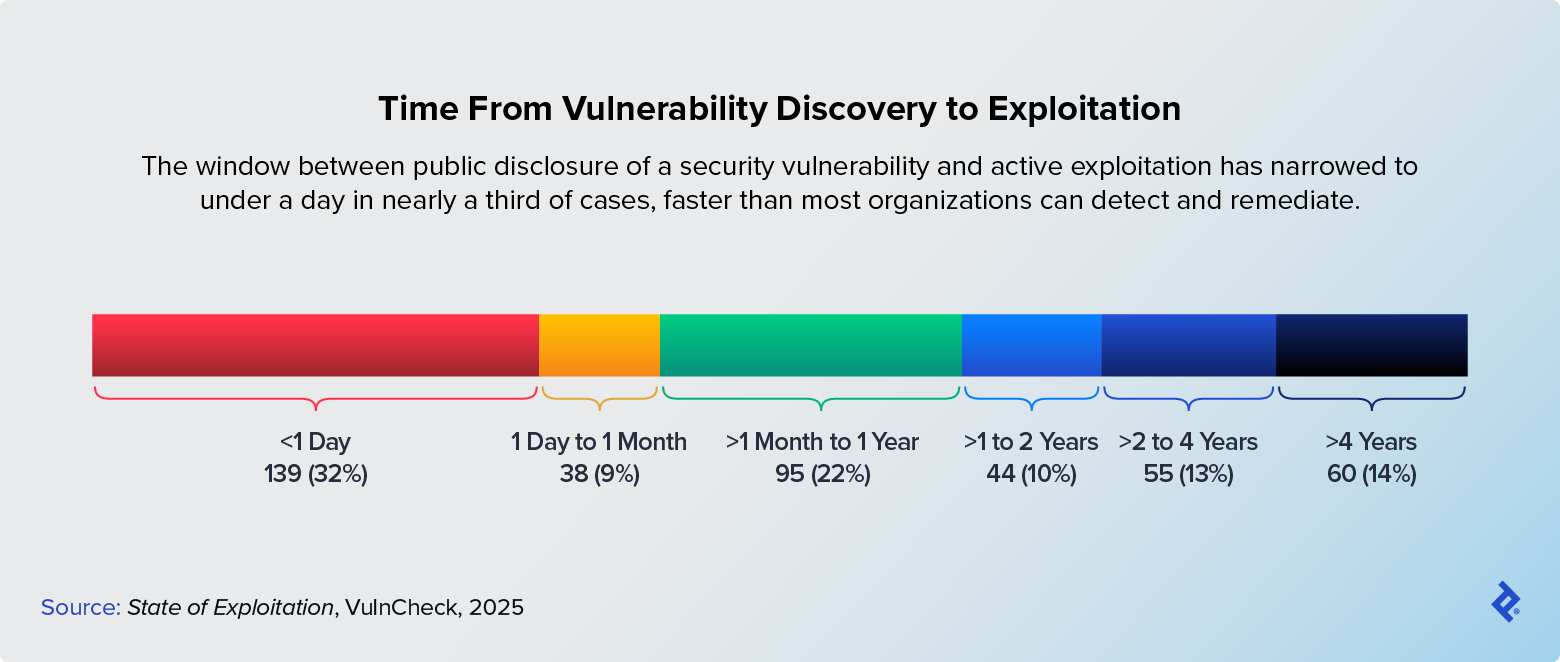
In our work with retail and consumer organizations, we see this timing gap show up as a recurring operational failure. Security staffing decisions are still made on quarterly or annual planning cycles, while the conditions that create risk often shift in days. Changes in customer behavior, payment flows, supply-chain integrations, or market exposure introduce new attack surfaces long before a role can be approved, hired, and onboarded.
By the time additional capacity arrives, teams are frequently addressing a different problem than the one that triggered the hire. The result is a persistent lag between where risk emerges and where expertise is available, leaving security leaders in a continuous state of catch-up rather than control.
Specialization Has Outpaced Job Descriptions
Modern cybersecurity no longer fits a generalist mold. Required expertise has fragmented into distinct domains, each with its own tooling, threat models, and operational context. On-premises security, for example, differs fundamentally from cloud-native environments. Compliance-driven work is not the same as application security. AI-related risks require hybrid skills that combine traditional controls with model auditing and adversarial defenses.
In regulated industries such as healthcare and life sciences, this fragmentation becomes especially visible. Security teams are often staffed to satisfy audits rather than to reflect how risk actually materializes. That’s a meaningful distinction: Compliance frameworks provide necessary structure, but they do not map cleanly to modern data flows, cloud architectures, or the way people actually work. As systems migrate to hyperscale platforms, teams accustomed to securing on-premises environments are suddenly responsible for identity, networking, and monitoring models that sit outside their direct control. Expertise that works reliably in one environment does not automatically translate to the other, creating coverage gaps that compliance-driven job descriptions rarely anticipate.
Short Risk Windows Drive Long-term Security Impact
Cybersecurity failures are rarely driven by novel or sophisticated attacks. Much more often, they result from delays in addressing known exposures during short, high-risk windows when the right expertise is not immediately available.
Evidence from recent breach and cost analyses reinforces this pattern. Verizon’s latest breach analysis, covering more than 22,000 security incidents and over 12,000 confirmed breaches, shows that exploitation of vulnerabilities now accounts for roughly 20% of initial access vectors, a 34% year-over-year increase. These breaches overwhelmingly involve known flaws in edge devices, VPNs, and misconfigured systems rather than undisclosed vulnerabilities. Median patching times remain around 32 days, creating a wide gap between exposure and remediation.
The financial effects of these delays are well documented. IBM’s Cost of a Data Breach research consistently shows that longer detection and containment times drive materially higher losses. In 2025, the average breach cost reached $4.44 million, with breaches taking longer than 200 days to resolve adding over $1 million in incremental costs. These increases are frequently tied to unpatched systems and incomplete response capabilities, not a lack of awareness.
Taken together, these findings highlight a consistent reality:
- The most damaging breaches exploit known, addressable weaknesses.
- Risk escalates during short, high-intensity periods.
- Timing, not novelty, determines both operational and financial impact.
In consumer-facing environments, for example, the consequences of this pattern extend well beyond technical risk. Security outcomes are measured as much by what does not happen as by what does. A single incident can dominate headlines, erode customer trust, and draw executive and board attention away from growth initiatives. As a result, security teams are often pulled into a defensive posture, prioritizing damage containment over enablement.
When specialized expertise cannot be mobilized quickly, product launches slow, integrations are deferred, and business teams learn to route around security instead of working with it. Over time, security becomes perceived as a constraint on delivery, even when the underlying issue is capacity arriving too late.
AI Is Reshaping Security Faster Than Workforce Models Can Adapt
AI is accelerating cybersecurity operations while simultaneously increasing the complexity of the risks teams must manage. Detection and response are becoming faster and more automated, but the skills required to govern and secure AI-enabled systems are evolving faster than traditional workforce models can adjust.
In many environments, AI reduces manual effort in early-stage security work, improving alert triage, pattern detection, and operational efficiency. As routine tasks become automated, human effort shifts toward oversight, validation, and risk judgment rather than execution.
At the same time, AI introduces exposure areas that fall outside traditional security domains, including model integrity, data governance, and risks tied to third-party AI services. Addressing these challenges requires hybrid expertise spanning security engineering, data science, and platform architecture, profiles that remain scarce and difficult to develop internally on short timelines.
Industry data reflects this strain. ISC2 identifies AI-related security skills among the most pressing workforce gaps, while Fortinet reports that candidates with specific cybersecurity AI experience are the second-most difficult to recruit, with 57% of organizations citing this challenge. Hiring behavior is already shifting in response: Toptal’s High-skilled Job Report for Q1 2026 notes that the security market is moving from resilience planning to execution, with demand concentrating on senior practitioners who can integrate identity security, governance, and AI-driven operations into live environments.
Like other modern cybersecurity risks, AI-related demand emerges unevenly, concentrating around deployments, integrations, and governance reviews rather than steady operational needs. This pattern further exposes the limits of static hiring models built for predictable staffing demand.
Designing Your Optimal, Elastic Security Workforce
In our work with security leaders across consumer, healthcare, and technology organizations, we see that effective workforce design requires operating on dual timelines. While permanent roles move through typical approval and hiring cycles, leaders also activate on-demand specialists to address immediate exposure tied to migrations, release cycles, regulatory deadlines, or other time-sensitive initiatives. This is the core-and-surge model: a stable internal team augmented by targeted expertise as concentrated risk demands it.
Over time, this elastic pattern improves hiring decisions. Leaders gain visibility into which capabilities require continuous ownership and which appear only during concentrated periods of risk. Staffing evolves alongside changing business conditions instead of remaining tied to assumptions made months earlier.
Effective elastic workforce design centers on three things: identifying where capability gaps concentrate, determining which responsibilities require long-term internal ownership, and establishing guardrails that allow specialized expertise to be deployed safely and predictably.
Step 1: Pinpoint Your Capability Gaps
When organizations struggle to close cybersecurity gaps, the instinct is often to jump straight to hiring. But teams that make real progress start by asking this: What capability is actually missing, and where does risk currently concentrate?
In our work assessing cybersecurity programs, we have found that capability-based frameworks are far more effective than role-based planning. Many organizations hire for broad titles such as security engineer, cloud security specialist, or governance, risk, and compliance (GRC) analyst, assuming those roles will cover evolving needs. In practice, risk rarely appears in role-shaped ways. It emerges in specific capability areas, such as identity architecture during a cloud migration, secure design review during a product release, or incident response readiness following a breach.
Capability-based assessments shift the focus from job titles and headcount to the functions a security program must actually perform. Instead of asking whom to hire, leaders map security into discrete functional domains, including governance, identity and access management, cloud security, application security, incident response, third-party risk, and metrics.
Viewed this way, cybersecurity stops looking like a single function and starts to resemble what it actually is: a system of interdependent capabilities that mature at different rates and experience risk in different ways.
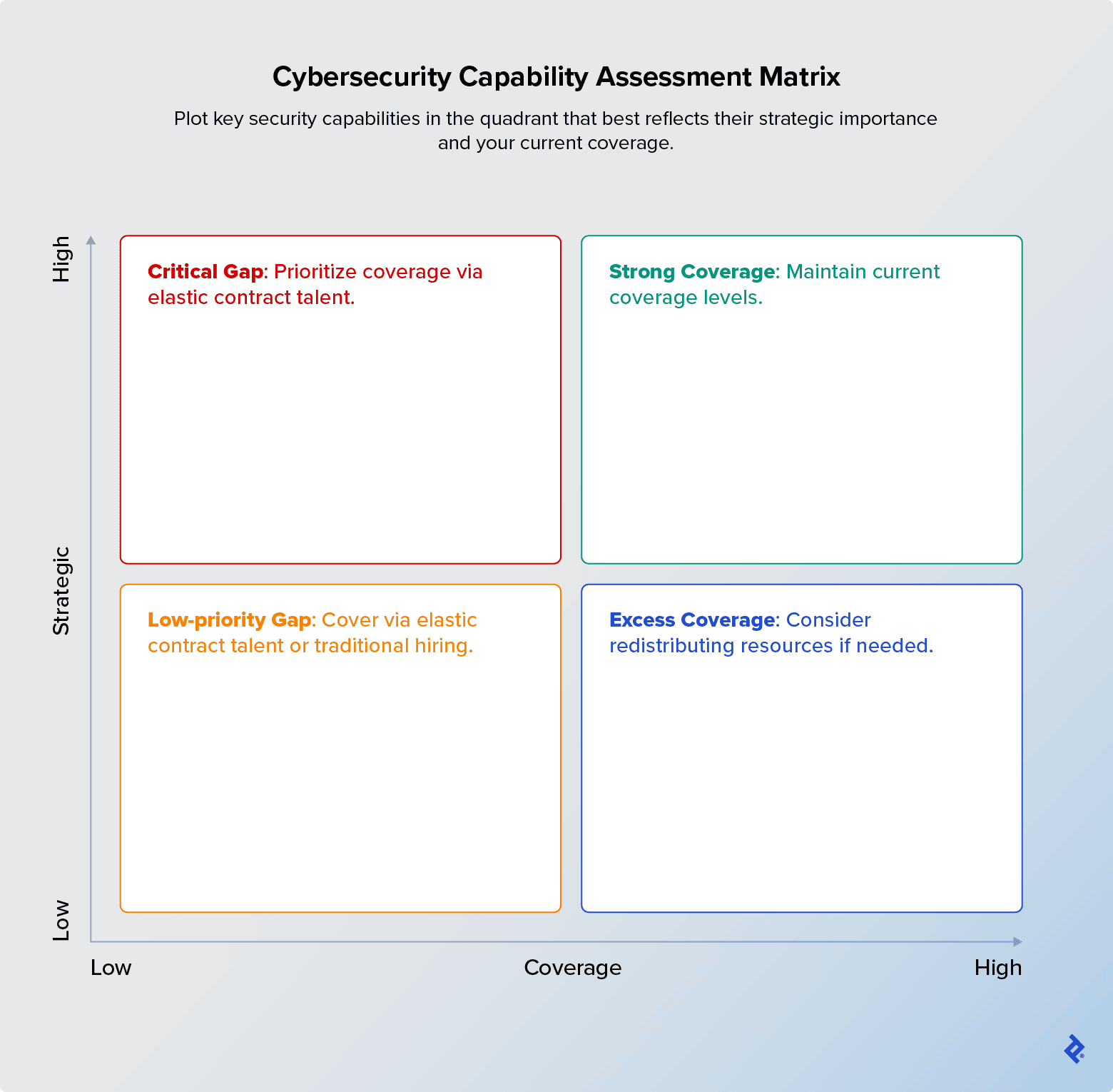
To make this concrete, plot your team’s capabilities onto the matrix below. Where each lands points to a specific next move.
Capability areas to consider:
- Detection and response: IAM, incident detection and response, EDR
- Proactive security: application security, cloud security configuration, vulnerability management
- Risk, compliance, and governance: third-party and supply chain risk, regulatory readiness
- Emerging risks: AI/ML risk management, security awareness, insider threat
Common Capability Gap Patterns
When organizations map themselves across these capability areas, we see the same patterns appear repeatedly. Domains that require continuous ownership and benefit from long-term institutional knowledge tend to be relatively mature and stable. These areas typically include identity and access management (IAM); baseline GRC; and security operations fundamentals, such as logging and alerting.
Other capabilities, by contrast, often remain underdeveloped until a triggering event exposes the gap. These areas typically surface only during moments of heightened risk, for example:
- Cloud security architecture during large-scale migrations
- Application security during major product releases or platform refactors
- Incident response readiness during or immediately after a breach
- Focused GRC support ahead of audits, certifications, or regulatory reviews
Very few organizations show even coverage across the full landscape, and almost none experience demand evenly across all areas. Risk concentrates unevenly, and capability requirements spike accordingly, especially in large, fast-scaling technology organizations.
In our work with Uber, for example, security maturity did not hinge on a single function or team, but on how capabilities surfaced under pressure as the business expanded globally. New risks emerged around identity, third-party access, data flows, and platform security that were not visible when systems operated at a smaller scale. Capabilities that appeared stable in areas such as identity governance, access management, and platform security evolved rapidly as growth, regulatory scrutiny, and architectural change introduced new complexity that existing structures were not designed to absorb. The capability mapping process we conducted with them made these imbalances explicit, revealing where depth was required temporarily and where long-term ownership needed reinforcement.
In regulated environments, capability mapping frequently reveals a different picture than expected. In our work with healthcare and life sciences organizations, for example, assessments often show strong maturity in policy, audit preparation, and perimeter controls, but weaker coverage in data governance, identity flows, and operational security tied to day-to-day workflows. Cloud migrations at these organizations exacerbate this imbalance, as sensitive data spans legacy systems, managed services, and third-party platforms, while accountability remains fragmented across teams.
What these assessments consistently show is that organizations are not missing “security people” in the abstract. They are missing specific capabilities at specific moments. As business conditions change, those gaps shift, making it impractical for any static team to cover them all without trade-offs.
Key Takeaway: Capability-based assessment shifts the focus from job titles to functions, revealing where specific expertise is missing and when it is needed most. This mapping forms the foundation for every staffing decision that follows.
Step 2: Deciding Which Core Capabilities Should Stay In-house
Large Organizations and Enterprises
For large firms, leadership, architecture, and risk decisions should be owned by full-time, internal security experts, while specialized cybersecurity services are brought in where they’re needed most.
Core security capabilities anchor decision-making and accountability across the organization, defining standards, owning risk decisions, and maintaining integration between security, engineering, and business teams over time. Unlike temporary projects, these functions tend to span years and remain tightly coupled to business strategy, platform evolution, and governance.
Other security needs surface unevenly, with demand increasing sharply around specific events such as cloud migrations, major application releases, GRC and compliance preparation, and elevated threat periods. In these cases, depth of experience and speed of onboarding matter more than permanence.
Small and Midsized Organizations
For small and midsized organizations, security workforce design tends to emerge from constraints. Teams are built incrementally, shaped by immediate risks, available resources, and the need to keep the business moving.
Most SMBs operate with a lean internal security footprint, even though they face the same categories of risk as larger enterprises, including ransomware, cloud misconfigurations, third-party exposure, and regulatory scrutiny. As a result, security programs must be built around a combination of limited internal ownership and targeted external support.
Where large enterprises anchor their core in a full security leadership structure, SMBs typically concentrate internal ownership in fewer roles: risk acceptance authority, security architecture, IAM governance, and overall security direction. These remain internal because they shape long-term strategy and organizational accountability regardless of company size.
Other capabilities fluctuate with operational events. Activities such as cloud-migration hardening, penetration testing, audit preparation, third-party risk assessments, and post-incident response support benefit from specialized expertise that can be activated when needed and stood down when the work is done.
|
Security Workforce Models by Organization Size
| ||
Staffing Approach | Large Enterprise Model | SMB/Midmarket Model |
Core in-house team | Security leadership, architecture, risk policy | Security strategy, IT management, data governance |
Elastic security workforce | Incident response, AI audits, application security | Compliance (SOC 2/HIPAA), cloud migrations |
Key benefits | Speed to market, scalability | Cost efficiency, expert guidance |
Over time, as organizations grow or regulatory pressure increases, the internal workforce develops alongside the business, adapting to changing exposure without forcing premature permanence.
Key Takeaway: Internal teams should own leadership, architecture, and risk decisions that shape long-term strategy, while specialized expertise is brought in for time-bound, episodic needs regardless of organization size.
Step 3: Establish Operational Guardrails
In our work with organizations interested in applying an elastic talent model, executives often express the same concerns: cost, overreliance on external talent, vetting, and compliance. Mature programs address these concerns upfront through structural solutions like defined scope and duration and rigorous vetting.
Define Scope and Duration Before Engagement
Elastic specialists should be engaged for defined time frames and specific needs, such as cloud architecture reviews, incident readiness, or audit preparation. Clear scopes make costs predictable and avoid the overhead of carrying underutilized full-time capacity between peak demand periods.
Keep Architecture and Decision-making Internal
Elastic specialists with specific capabilities should be brought on within defined workstreams, not treated as general substitutes for internal teams. Internal staff and leaders should retain ownership of architecture, prioritization, and decision-making, while external expertise augments execution during concentrated risk periods.
Require Rigorous Vetting
Vetting and trust in security personnel are nonnegotiable. Typical ad hoc contracting may introduce risk that traditional full-time hiring would screen out. Instead, partner with a security consulting provider that relies on heavily vetted professionals with proven security experience, background verification, and references. Treat this bar as nonnegotiable, no matter how quickly your needs arise, so that you can move quickly without compromising standards.
Apply Consistent Access Controls to External Specialists
Elastic specialists should operate under the same zero-trust principles applied to internal staff: least-privilege access, time-bound credentials, activity logging, and clear separation of duties. External specialists work within clearly defined scopes, while internal leaders retain ownership of security decisions, risk acceptance, and oversight.
With these guardrails in place, elasticity becomes a controlled operating model, allowing security leaders to scale capability without introducing new categories of risk.
Key Takeaway: Defined scope, internal ownership of decisions, rigorous vetting, and consistent access controls turn elasticity into a controlled operating model that scales capability without introducing new categories of risk.
What to Do Next
Closing the cybersecurity skills gap starts with treating workforce design as a risk management decision.
Leaders can begin by mapping security capabilities against how risk actually appears in their organization. Some functions require continuous internal ownership, context, and authority. Others surface in concentrated periods tied to audits, platform changes, incidents, or product launches.
From there, organizations can design staffing models around timing and depth rather than headcount. That includes defining which capabilities must be owned internally, which can be activated on demand, and how external specialists integrate into existing controls, workflows, and governance structures.
Finally, execution matters. Effective models rely on vetted talent, clear scopes, time-bound access, and measurable outcomes. When these elements are in place, flexibility strengthens accountability rather than weakening it.
For executives, the path forward is concrete: Assess capability coverage, align staffing with how risk actually emerges, and build mechanisms to access specialized expertise when it matters most. Organizations that adopt this approach move from reacting to risk after it appears to positioning expertise where risk is likely to surface next. In an environment where threats evolve faster than traditional hiring cycles, workforce design becomes a core component of security resilience itself.
Have a question for Zohra or her Cyber and Information Security team? Get in touch.
Understanding the basics
The cybersecurity skills gap is the structural mismatch between the specialized security expertise organizations need and what their current workforce models can deliver. It shows up when teams lack ready access to specific capabilities during critical moments, such as cloud migrations, audit cycles, or active incidents. Traditional hiring cycles take months to fill roles, while cyber risks emerge and require expert response within days.
Companies face many challenges due to the cybersecurity skills gap, including delayed incident response and breach detection. When specialized expertise is unavailable during high-risk periods, vulnerabilities persist longer than necessary, and incidents grow more expensive. Security teams are often pulled into reactive modes, prioritizing damage control over strategic initiatives. This limits their ability to support digital transformation and creates friction between security and business teams.
The cybersecurity skills gap increases both the likelihood and the cost of breaches. Breaches resolved in under 200 days cost an average of $3.87 million, while those exceeding 200 days cost $5.01 million, according to IBM’s 2025 Cost of a Data Breach Report. The gap also leaves emerging risk areas, such as AI security and cloud architecture, inadequately covered.
The industries most affected by the cybersecurity skills gap include healthcare, financial services, and retail. Healthcare organizations face strict regulatory requirements alongside complex data flows and legacy systems. Retail and consumer companies manage large volumes of customer data across distributed environments, often without the internal security depth required. However, the skills gap affects organizations across all sectors, as every industry faces similar pressures around cloud migration, AI adoption, and compliance.
Organizations can bridge the cybersecurity skills gap by mapping security capabilities against how risk actually surfaces. Some functions require continuous internal ownership, such as security leadership and architecture. Others, like cloud security during migrations or compliance ahead of audits, surface episodically and benefit from elastic access to specialized expertise. Effective models combine permanent roles for core functions with flexible access to specialists for high-intensity, time-bound needs.
AI and automation can mitigate the cybersecurity skills gap by cutting manual work across detection, triage, and response, allowing smaller teams to cover more ground. AI accelerates threat identification, reduces alert fatigue, and enables faster containment. In fact, organizations using AI-driven security tools extensively see breach costs averaging $3.62 million, compared to $5.52 million for those without these tools, according to IBM’s 2025 Cost of a Data Breach Report.

About the author
Zohra is the Cyber and Information Security Practice Lead at Toptal, where she drives enterprise risk management, cybersecurity strategy, IT governance, and regulatory compliance initiatives across Fortune 500 clients and global organizations. Previously, she held leadership positions in security and compliance at Grant Thornton and McCormick & Company. She holds two bachelor’s degrees from the University of Maryland, one in accounting and one in information systems.
PREVIOUSLY AT