
Marketing Strategy in the AI Era: A New Mandate for CMOs
As AI reshapes marketing, CMOs operate in a far more demanding environment than they did just a few years ago. Jeff Gangemi shares what the sharpest marketing leaders are doing to meet new expectations.

As AI reshapes marketing, CMOs operate in a far more demanding environment than they did just a few years ago. Jeff Gangemi shares what the sharpest marketing leaders are doing to meet new expectations.

Jeff is the Growth and Digital Marketing Practice Lead at Toptal. He holds a bachelor’s degree from Middlebury College and an MBA from Cornell University with an emphasis in leadership and innovation. Jeff has spent the past 15 years building demand generation, content marketing, and digital programs that drive meaningful transformation and growth for both internal teams and external clients. Before joining Toptal, he held senior management roles at Accenture Song, Material, and Telus International.
Previously At


Not long ago, most technology CMOs were evaluated primarily on their ability to build brand awareness and shape a company’s market presence. The role sat close to the center of the business, but often operated as a distinct function: Marketing drove visibility and demand, while revenue and operational strategy sat elsewhere. Marketing and sales teams rarely aligned on what made a quality lead and thus how to drive pipeline effectively. Those days are long gone.
Today’s CMOs work in a far more demanding environment, where marketing is expected to actively shape and drive measurable business outcomes, not simply support them. Sales and marketing alignment is no longer a luxury; it’s become an absolute requirement.
Across several interviews with top marketing leaders from a range of tech companies, executives described a role being transformed simultaneously by AI, leaner business models, and rising pressure to demonstrate revenue impact more directly.
Those conversations revealed that the CMOs succeeding in this environment are operating beyond their traditional boundaries, moving credibly between creative, technical, and commercial disciplines. This article explores the key factors shaping CMO strategy today and how the sharpest minds in marketing are responding.
Marketing’s Increasing Influence in the Boardroom
The CMO role carries a whole new level of commercial exposure than it did just a few years ago. Marketing leaders I talked to are signing up to own revenue numbers directly, tying their credibility, and often their job security, to metrics traditionally associated with sales. The change is subtle but important: It’s one thing to influence pipeline, another to be held formally accountable for it.
For a CMO to justify their place at the executive table, they need “to own at least one of the sales stages,” says Trinity Nguyen, CMO of sales intelligence platform UserGems. “If we miss that number, we’re out the door.” Nguyen also believes this ownership is creating tighter alignment at the leadership level. “If you say you’re accountable for stage-two, sales-accepted pipeline, then the chief revenue officer (CRO) can do the math on what they’re accountable for with the board, and we can build a true partnership.”
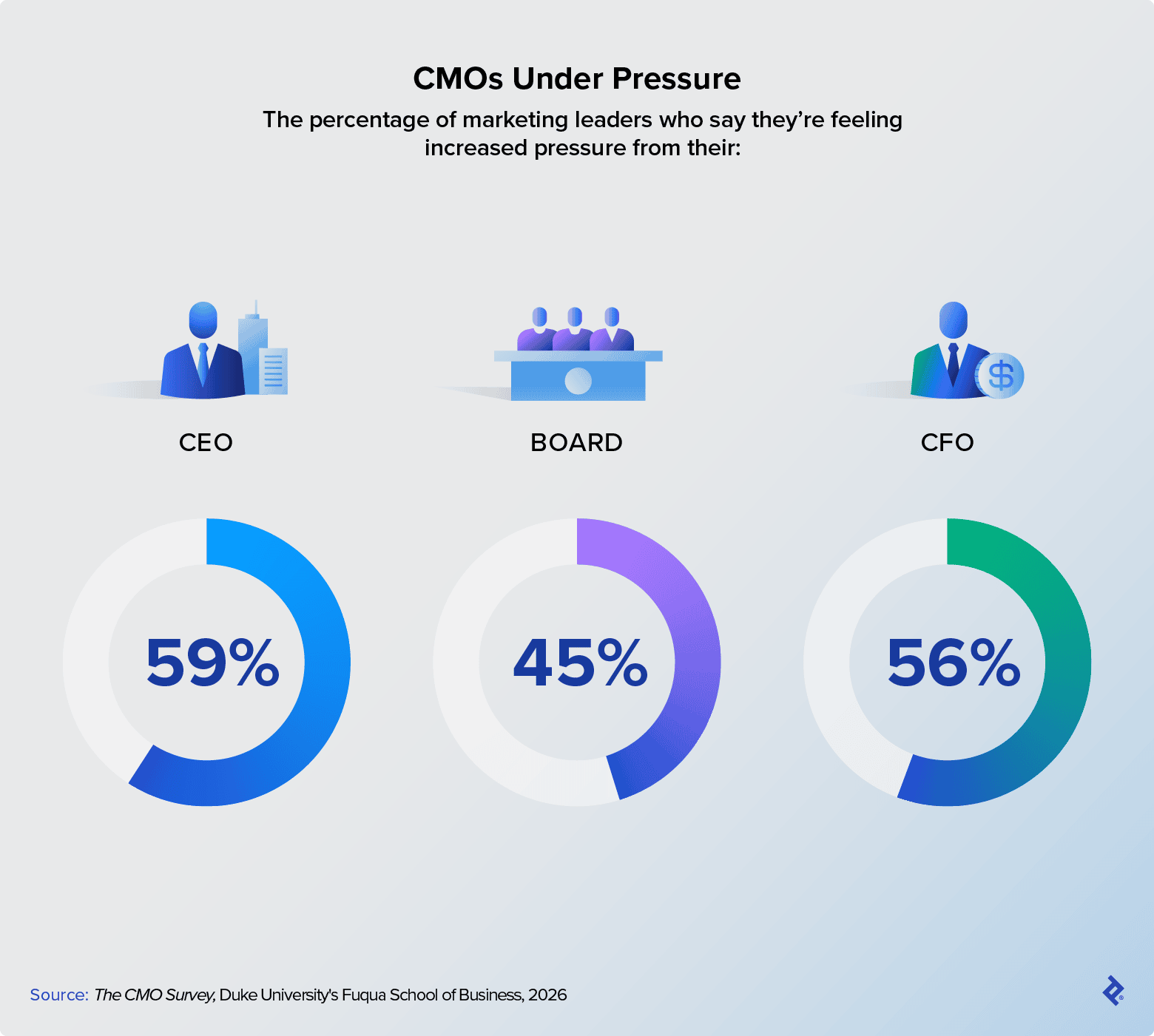
A majority of CMOs feel increased pressure from the CEO and CFO to prove marketing’s value, according to the 2026 CMO Survey by Duke University’s Fuqua School of Business. There used to be a perception that marketing work was “fluffy,” Nguyen says. But being accountable for sales makes the work concrete and more visible to leadership.
“My compensation bonus is tied to net revenue; the same number my CRO is measured on,” Nguyen continues. “That’s how I build my relationship with the CEO and with sales. We’re working in the same funnel, trying to hit the same number.”
As revenue ownership becomes more integrated across marketing and sales, the separation between demand generation and pipeline execution is shrinking. CMOs are often involved in shaping growth strategy itself: determining where the business channels its resources and how targets are achieved across the funnel.
A New Executive Skill Set
Several leaders I talked to for this piece described this growing commercial accountability as redefining the knowledge required of modern marketing leaders. CMOs are expected to understand campaign performance and attribution, as well as the broader mechanics of how the business makes money: pipeline velocity, acquisition efficiency, retention dynamics, and margin realities.
“A lot of marketing leaders would like to do marketing how they’ve always done it, but to be successful right now you have to have a super strong command of financial and unit economics,” says Kathleen Booth, VP of Marketing at virtual event platform Sequel.io. “That’s the information you need to make decisions.”
CMOs aren’t necessarily expected to become financial experts, but they need to demonstrate how marketing decisions affect revenue outcomes with the same clarity as other executives in the C-suite. “The CMOs struggling right now are great storytellers who can’t hold their ground in a pipeline review,” says Kyle Lacy, CMO of AI-powered learning platform Docebo. “You have to do both now. You can’t hide behind brand anymore.”
In short, the role now demands a knowledge base that many marketing leaders never previously needed. CMOs must be able to defend assumptions, challenge forecasts, and hold their ground in board-level discussions. If you can’t confidently communicate those numbers to the board, then “no matter how good you are, you’re out,” says Tyler Calder, CMO of PartnerStack. “You need to be as confident as the CFO, the CRO, the CEO.”
The leaders I spoke with emphasized that, while executive influence is clearly built through analysis, the relational aspects remain critical to building a high-performing organization. As marketing becomes more deeply embedded in company strategy, the ability to navigate tension, disagreement, and uncertainty across leadership teams is increasingly important.
“Your relationship with the CEO is the single most important factor in your success as a CMO,” says Booth. “You’re essentially getting married. You need to be able to work well as partners, through the hard conversations.”
The Impact of Widespread AI Adoption on Tech CMOs
While growing commercial accountability has expanded the scope of the technology CMO role, few developments have altered the day-to-day reality of it as quickly as generative AI. In addition to upending content production and workflow automation, it is reshaping team structures, hiring decisions, and tooling choices.
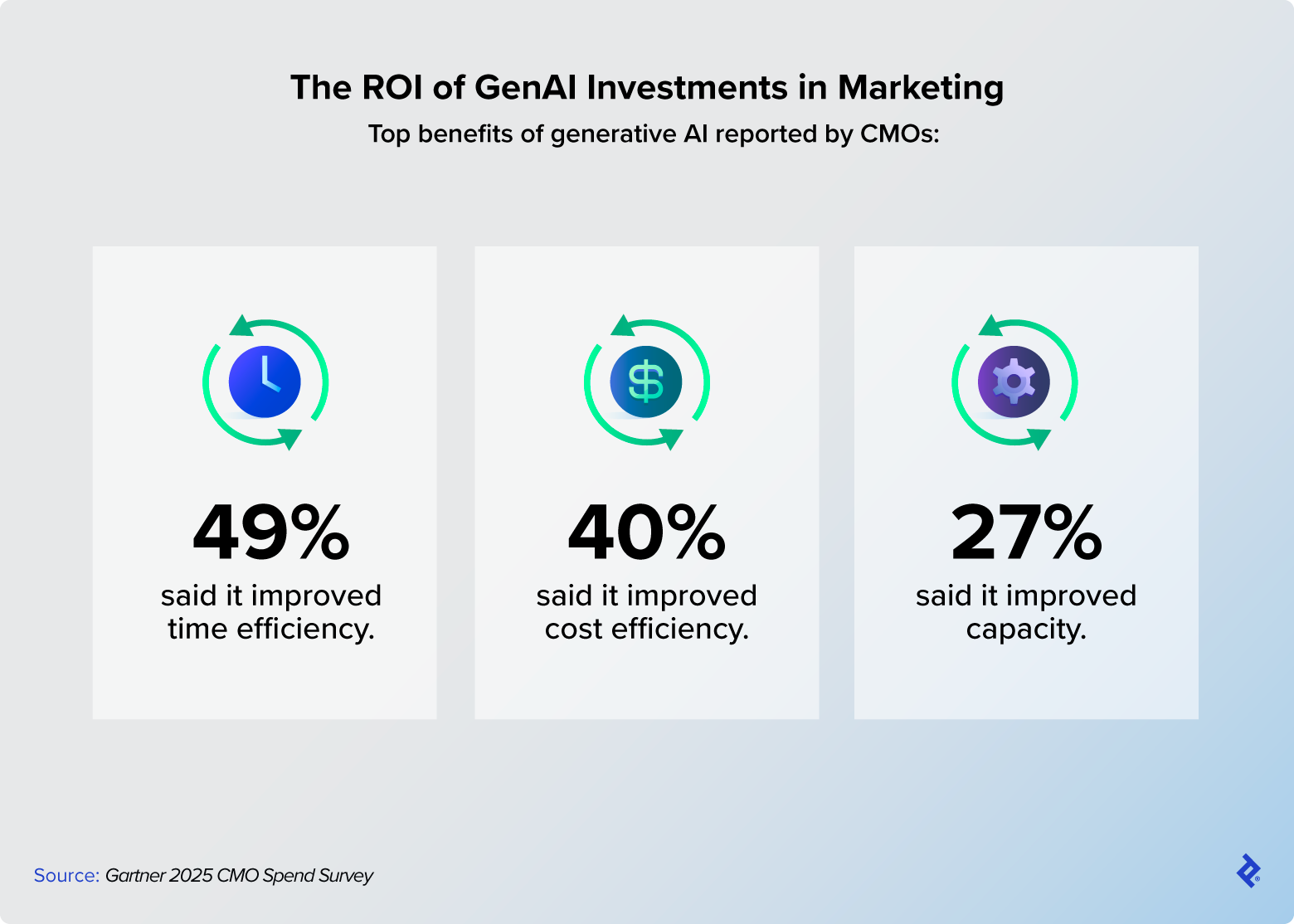
Findings from the Gartner 2025 CMO Spend Survey indicate investments in generative AI are already delivering ROI in several areas: 49% of respondents reported improved time efficiency, 40% said it’s reducing costs, and 27% point to greater capacity for content production. Just 1% said generative AI investments were not currently a priority.
For many CMOs, the central question they now face is how extensively to reorganize marketing around it. The proliferation of AI in marketing has fueled a sharp escalation in expectations around efficiency and output, meaning marketing teams are being asked to produce more content across more channels without proportional increases in team size.
“You can execute faster, often better, with the same number of people or fewer, so you don’t need bloated teams,” says fractional CMO Hugo Pereira, who has worked with Frends iPaaS and Software Improvement Group. These efficiency gains are informing organizational decisions: The Gartner survey found that 39% of CMOs are looking to reduce labor spend, primarily by simplifying overlapping roles and cutting total headcount.
Where CMOs once prioritized building diversified, full-time teams, the pressures created by AI mean they are now focused on optimizing team structures for impact. The CMOs I talked to said it’s not just about doing more with less, but doing more of the right things without overbuilding.
Another key task for CMOs is to consider which parts of marketing operations will benefit most from AI, and which depend on creativity and interpretation. “You need to be able to look at your department, your function, every role, and spot where human judgment still matters most, and where it doesn’t,” says Booth. “That’s the new job.”
Lacy agrees. “When you can automate the first draft of almost anything, the question becomes: What does the human bring that AI can’t? Judgment. Creative risk. Relationships. That’s what I’m protecting on my team.”
Why AI Literacy Matters
Other leaders described AI fluency as rapidly becoming a core executive capability. CMOs must understand how information moves across platforms, how automation layers interact, and which use cases genuinely improve outcomes. Many are actively upskilling through courses and hands-on experimentation to get a better grasp of how AI systems in marketing work.
First-hand, in-the-trenches AI experience is now a vital component of leadership, says Justin Holmes, CMO at restaurant software company 7shifts. “To really leverage what’s possible now, you need to understand what a database is and how to store data, what workflow automation looks like, how to push things to tools that send emails,” he says. “If you can’t show the team what’s possible, you’re just hoping someone stumbles onto it.”
AI is also affecting one of marketing’s most foundational responsibilities: top-of-funnel customer awareness and discovery. “A lot of the data is showing that the first step in discovery for B2B buyers is AI,” says Calder. People are using generative platforms to research vendors and compare products before ever visiting a company website.
That creates a new problem for CMOs because companies have less direct control over how their products, positioning, and brand narratives are interpreted during early-stage research. Increasingly, leaders must think beyond how content ranks in search engines and develop a clear GEO strategy to have more influence over how information is surfaced and summarized inside AI-generated responses. The message on GEO is clear: Controlling the narrative around your company and products, mostly on your owned channels, but across third-party sites as well, is an absolute requirement.
A Balancing Act: CMO as Brand Steward and Growth Architect
Another defining challenge of the modern CMO role is balancing immediate revenue pressure with the slower work of building market trust. That balance is proving difficult to maintain: Deloitte’s survey found that 71% of CMOs now prioritize short-term impact over long-term gains. While a focus on performance marketing is understandable and can deliver measurable results, successful CMOs don’t let the pendulum swing too far in either direction. Why? Because sustained underinvestment in brand risks weakening the recognition that influences buying decisions at the bottom of the funnel.
The tension between revenue and reputation has become more pronounced as software categories grow increasingly crowded and competing products become harder to differentiate. In that environment, brand marketing is a powerful lever for credibility, pricing power, and customer loyalty, in addition to boosting the efficiency of future acquisition efforts. Strong brands reduce friction throughout the buying journey, as customers arrive with familiarity and trust.
“I don’t think of brand and revenue as two separate things, but as a continuum across the entire customer journey,” says Allyson Havener, former CMO of software review platform TrustRadius. “Teams are always going to be at odds if you don’t think brand is tied to revenue.”
It’s a view shared by Brenna Loury, former CMO and current CRO of productivity software company Todoist. “Without brand and brand architecture, it’s easy to get into a race to the bottom,” she says. “Our whole brand strategy has been built around trustworthiness and human connection, and I feel very validated that people are finally wising up that this stuff matters.”
Building the Case for Brand Investment
For Loury, brand is a foundational element of commercial performance, but that doesn’t mean every company should prioritize brand investment equally at every stage of growth. Many CMOs believe it isn’t about choosing between brand and performance, but determining how to sequence them.
Particularly in early-stage or high-growth companies, marketing leaders are expected to establish commercial credibility (read: product-market fit) first, before earning the latitude to invest more heavily in long-term brand building. Many of the activities that strengthen market position simply take longer to show up in the metrics that executives review most closely.
“My recommendation to any marketing leader is to focus on performance first. You need to generate pipeline,” says Nguyen. “Once you have programs running, that buys you the freedom to start experimenting with brand.”
4 Principles of Modern CMO Marketing Strategy
The pressures facing marketing leaders may be broad, but the solutions are surprisingly focused. There is limited value in chasing new tactics, channels, and tools simultaneously. Many CMOs are instead concentrating on a smaller set of priorities centered around four critical areas: linking marketing activity to business objectives, building durable brand foundations, improving the quality and usability of marketing data, and creating teams designed for adaptability and ownership. Here’s how leading CMOs are taking action.
1. Tie Marketing Directly to Revenue
Revenue responsibility is changing how CMOs think about marketing strategy itself. Brand, positioning, customer experience, and life-cycle engagement can’t operate as loosely connected activities or be managed in parallel. Performance is now dependent on how effectively those pieces work together.
A greater connection between marketing decisions and business outcomes means CMOs must also pay more attention to which marketing channels, customers, and messages actually create durable value for the business. A given campaign may fill the funnel and look successful in isolation, but attract low-fit customers.
This is one reason marketing plans built primarily around reach or lead volume are giving way to more commercially focused approaches that prioritize conversion quality and long-term customer value, according to the CMOs I spoke with. Instead of spreading resources across generic campaigns with limited strategic potential, they are concentrating investment where it can deliver sustainable growth for the business.
Positioning influences conversion rates, better audience targeting increases pipeline quality, and consistent messaging improves retention. Once the CMO makes those relationships visible, marketing carries much greater weight in the boardroom.
Key Takeaways for CMOs
- Align marketing priorities directly with commercial objectives, ensuring all campaigns support measurable revenue targets.
- Evaluate performance through pipeline quality, retention, and customer value instead of lead volume alone.
- Build shared planning processes with sales, product, and finance teams around common goals so strategy is closely coordinated.
- Allocate marketing investment toward channels and programs that attract higher-value customers rather than simply generating temporary acquisition spikes.
2. Treat Brand as a Pillar, Not an Afterthought
Long-term brand building can be difficult to prioritize alongside immediate pipeline goals when a CMO is trying to demonstrate measurable impact. Yet many marketing leaders continue to view brand as foundational to sustainable growth rather than separate from it.
“In the new AI landscape, people are going to get jaded with the sea of AI sameness,” says Booth. “Marketing is always about how to stand out, so I think it’s important to lean into things that are uniquely yours. That has been seen as nice to have, but I think brand is having a renaissance.”
In crowded software markets, where multiple products and companies are evaluated within seconds, consistent messaging and strong market recognition help companies establish credibility early on. They also create differentiation that extends beyond singular features, which is becoming more valuable as AI-generated content makes marketing increasingly homogenized.
The challenge is sustaining a clear identity and keeping positioning aligned while still moving quickly. This involves a mindset shift: Treat brand not as a campaign layer, but as a system that shapes how the company is understood over time.
Key Takeaways for CMOs
- Establish clear messaging frameworks that teams can apply consistently across channels and campaigns.
- Define brand guardrails so teams can execute quickly without fragmenting the narrative.
- Audit customer touchpoints regularly to identify inconsistencies between marketing, sales, product, and customer experience.
- Clarify positioning by aligning brand story around specific customer problems rather than relying on feature-based competition.
- Track brand health alongside pipeline and conversion metrics to maintain visibility into market perception.
3. Establish a Strong Data Foundation
Many marketing functions are moving fast to adopt AI and automation tools, but speed can expose operational weaknesses just as easily as it creates efficiencies. AI-driven reporting, forecasting, and attribution all depend on the quality of the underlying data feeding those systems.
This is also true for personalization, notes Lacy. “Get the foundation right before worrying about personalization. Personalization on bad data just means sending the wrong message faster. Clean account, solid intent signals, alignment with sales on what they’re seeing … then the personalization layer actually makes sense.”
Strong data foundations matter just as much for the rest of the marketing technology stack. If data is inconsistent, new tools can scale confusion, increase noise, and leave teams struggling to measure performance accurately. Greater data accuracy, on the other hand, enables better reporting, making it easier for marketing leaders to communicate impact and justify future investment.
Key Takeaways for CMOs
- Establish consistent customer data and taxonomy standards before expanding AI initiatives.
- Align marketing and sales around shared definitions for attribution and pipeline stages.
- Evaluate existing tools to identify if they’re contributing measurable operational or commercial value.
- Build reporting systems that connect marketing activity to revenue performance and broader business outcomes.
- Expand KPI tracking beyond volume metrics to include engagement quality, pipeline contribution, and marketing efficiency ratio.
4. Hire for the Skills That Matter
AI is changing the kinds of human skills that offer the most value. This is causing many marketing leaders to bring in specialized skill sets, often as fractional CMOs, focused on strategy, systems thinking, analysis, and cross-functional execution. Roles such as GTM engineers, RevOps specialists, and growth analysts are becoming more common as companies look for people who can connect workflows and help marketing teams operate more efficiently.
The demand is not simply for technical specialists, however. It’s for operators who have real experience bridging that expertise with commercial thinking. “What I’m looking for in my next RevOps or GTM hire is someone who has a revenue mindset, is systems-savvy, and is AI-curious,” says Nguyen. “The GTM engineer can be so fixated on playing with tools that they forget their main job is to drive revenue.”
Flatter team structures require people who can operate independently and take ownership beyond narrowly defined responsibilities. “I want everyone on my team to be in a position where they aren’t turning to me on most of their questions,” says Charles Groome, VP of Marketing at work intelligence platform Insightful. “I want to delegate ownership, not delegate tasks. Instead of asking someone to do a thing, I need them to own an outcome. That’s the skill that’s differentiating right now.”
AI is also increasing the value of softer interpretive and strategic capabilities, particularly in B2C outfits. As more production work becomes automated, qualities such as creativity and business acumen are harder to replicate.
“Above all, I’m hiring for creativity, taste, strategic thinking, and commercial awareness, not commercial obsession,” says Loury. “I want everyone to understand how what they do relates to business success, but I don’t want my marketing team to believe that everything they do has to translate directly to a monetary output.”
Key Takeaways for CMOs
- Redesign hiring processes to evaluate operational fluency and even creativity alongside pure channel knowledge.
- Audit workflows to identify where automation offers meaningful improvements and where human review should remain.
- Create clearer ownership so teams are accountable for business outcomes instead of isolated deliverables.
- Review team structures regularly to identify unnecessary management layers or duplicated work.
A New Era of Marketing Leadership
The role of the modern tech CMO has become unusually expansive. Few executive positions sit across revenue, product, operations, customer experience, and business strategy at the same time. That breadth creates pressure, but it also creates opportunity.
Today’s strongest marketing leaders are comfortable operating inside consistent complexity, moving between commercial discussions and creative decisions without treating them as separate disciplines. They understand enough about systems, automation, and data to influence how marketing departments operate, while still recognizing the importance of judgment, taste, trust, and narrative.
Perhaps most significantly, many no longer view marketing as a support function; it’s now central to how technology companies grow, compete, and communicate value in ever-more crowded markets.
For Groome, that breadth is precisely what makes the position compelling. “The CMO role is generative,” he says. “It’s about creating value, not optimizing for value. The CFO optimizes a single KPI. The CMO covers the full span: highly adept technologically, highly analytical, and still responsible for creativity. It’s the perfect seat to be a business owner in a tech-driven world.”
The scope of this new role might seem intimidating to some. As if it wasn’t already hard enough, marketing leaders are now expected to act as analysts, strategists, and creatives. They’re expected to produce more efficient growth and stronger outcomes, with leaner teams and under greater scrutiny. Beneath those competing demands, however, lurk two skills CMOs have always possessed: the ability to translate and communicate. Converting brand into revenue, data into action, and customer behavior into business strategy has always been a fundamental part of the job, and it likely always will be.
Have a question for Jeff or his Marketing team? Get in touch.
Understanding the basics
A chief marketing officer (CMO) is the executive responsible for overseeing a company’s marketing strategy, brand positioning, customer acquisition, and growth initiatives.
A CMO leads a company’s marketing function. Their role is to understand customers, shape how the company is presented to the market, and create marketing programs that generate demand and support growth. They are also responsible for managing marketing teams, budgets, and overall performance.
A new CMO typically starts by understanding the company’s goals, customers, and existing performance before deciding what needs to change. From there, they align marketing priorities with business objectives, focus resources on the highest-impact opportunities, and establish clear measures of success that can be tracked over time.

About the author
Jeff is the Growth and Digital Marketing Practice Lead at Toptal. He holds a bachelor’s degree from Middlebury College and an MBA from Cornell University with an emphasis in leadership and innovation. Jeff has spent the past 15 years building demand generation, content marketing, and digital programs that drive meaningful transformation and growth for both internal teams and external clients. Before joining Toptal, he held senior management roles at Accenture Song, Material, and Telus International.
PREVIOUSLY AT